
The Grapes of Wrath: Discussion II
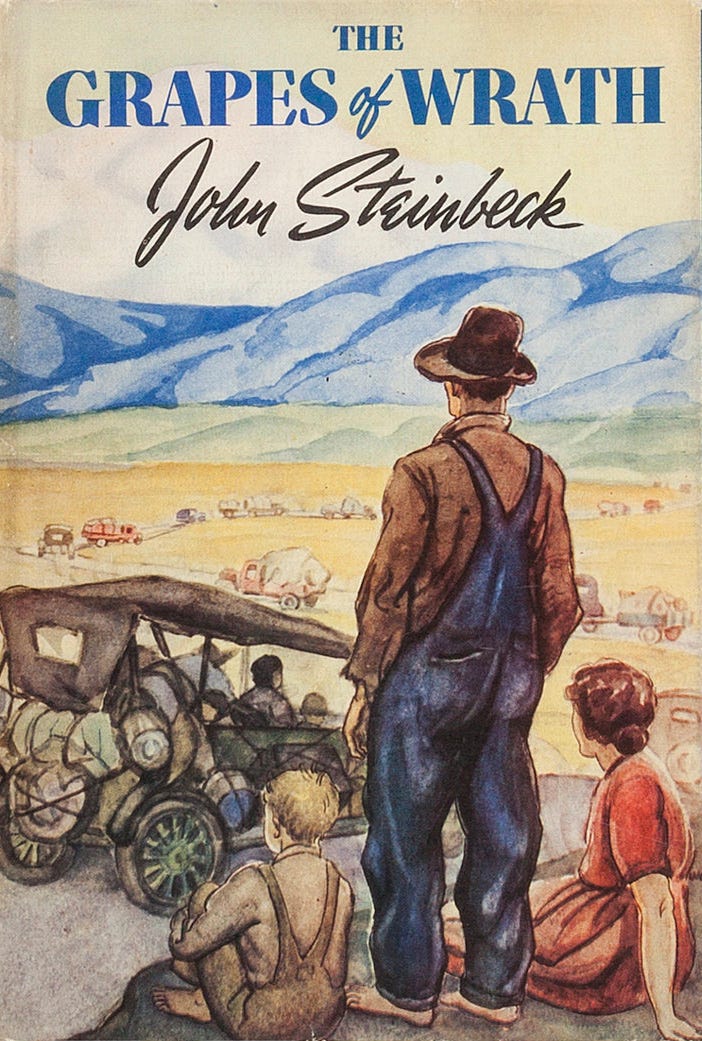
Chapters 7-14: Home in the rearview, the Mother Road, and dreams of oranges

Initial thoughts
This is turning out to be a compelling work. The family’s heart-wrenching journey has just begun in earnest, we have many interesting characters whose arcs have yet to even really begin, and on top of that the work is suffused with an insistence on human dignity, and a politics that almost feels radical. I’m really liking it so far. Let’s jump in.
Chapter 7
This chapter opens up with yet another vivid illustration of the one man exploiting another. The salesman prowls the yard, observing the buyers, “looking for weakness.” The families searching for cars are already desperate, but the owners have no qualms about ripping them off for a buck
“Hot sun on rusted metal. Oil on the ground. People wandering in, bewildered, needing a car.” Simple but evocative paragraph, really sums up the whole scene.
The owners mock the man who comes trying to trade his mule. “Didn’t anyone tell you this is the machine age?” Here again we see the disrupting effects of technology. As the tractor renders the farmer obsolete, so the automobile does the mule. The progress is unstoppable but leaves families behind, families whose possessions once had value. Their change in fortune is simply a business opportunity to some.
On page 65, the dissatisfied customer, who was sold a piece of junk, is not treated with dignity or respect but only hostility. He made the purchase and that is final, despite the car being misrepresented. When he threatens to not make payments, he is threatened with both the bank and the police. The consumer, already desperate, has no recourse from the shady business practices.
Chapter 8
I really liked the description of the stray dogs in the road as Joad and Casy travel, “dogs whose breeds had been blurred by a freedom of social life.” This appears to echo earlier themes we discussed regarding freedom, in that these mutts, descending from once distinct breeds for specific tasks, have now all intermingled and interbred. No longer pure guard dogs or sheep dogs, they’re free to do what they want apart from their predetermined roles, which in this case is chasing bitches.
A further look into Casy’s character when he laughs at a joke: he admits to being repressed when he was a priest, unable to laugh at a dirty joke or to even cuss (70)
The old truck that is being packed up when Tom finally arrives at the family home stands out immediately as a symbol, a symbol of change, movement, desperation
Old Tom immediately stands out as rugged. Old clothes and old shoes but forceful, strong. There is an awkwardness about his interactions with young Tom, as though he is unable to fully express his emotions (72)
Ma is depicted as central, the “citadel of the family,” a healer, an arbiter, and a source of strength
Hospitality seems runs through the novel, witnessed in this case by Ma’s immediate acceptance and hospitality toward Casy
Tom expresses anger to his mother about what happened to their home. Ma says, “They say there’s a hun’erd thousand of us shoved out. If we was all mad the same way, Tommy—the wouldn’t hunt nobody down—”. This is emerging as a central theme in the text, an assertion of strength in unity and weakness in division, a division displayed in Joe Davis, who runs the tractor over his neighbor’s land. He is angry, too, about his own misfortune, but chooses to stand above his neighbor than with him (77)
The portraits of Grandma and Grandpa aren’t particularly flattering, and what Grampa represents becomes obvious over the next few chapters (if it’s not obvious already). But I did find the bit about her shooting Grampa in the ass and him afterward him not trying “to torture her as a child tortures bugs.” The comparison here is a bit shocking and concerning, and seems to be suggestive of a relationship that was once quite dark and cruel. But the other notable element here is the role of the gun, once again used as a way for one to preserve one’s dignity, when no other option is available.
Joad talks of picking an orange whenever he wants when they finally get to California, and this theme of picking fruit will return again and again, expressed by many in the story, a clear symbol of the Promised Land status they have all attributed to California, alongside the white house
Chapter 9
This chapter is heartbreaking, depicting a family packing up, selling off their belongings, preparing to move on from their homes forever
“Can’t sell a hand plow no more” —another acknowledgement of the changing times, the disrupting power of technology
“You’re not buying junk, you’re buying junked lives.” The junk man too is an exploiter, taking advantage of folks who have no choice but to sell off most of their belongings
“They aren’t just buying a horse, they’re buying a “little girl plaiting the forelocks…” Here Steinbeck steps away from the dispassion and economics driving this desperation and migration and strikes at the tragedy of it all, the lives that have now become memories, all the things sold off that once meant so much to people, like a horse to a little girl
“The anger of a moment, the thousand pictures, that’s us. This land, this red land, is us; and the flood years and the dust years and the drought years are us. We can’t start again.” Damn.
There is a bitterness at the destruction of their homes that will stay with them, even if they make it to California. The bitterness will never leave.
How can we live without our lives? Steinbeck asks, and it sums up what these families are facing perfectly.
Chapter 10
I liked how Steinbeck referred to the clothes Ma was handling as cords of wood—I think it helped further define her character as strong, laborious, and essential
Casy reaffirms the new definition of holiness that he will follow once he gets to California, one dependent on connecting with his community and earth. This includes walking in the grass, singing, and, oddly, listening to a husband nailing his wife?
Rosasharn, or Rose of Sharon, which is really annoying to read repeatedly, is introduced here, and strikes me as a somewhat obvious symbol of fertility, motherhood, and resilience, though we’ve yet to see much of her character
Uncle John is quite the interesting parallel to Casy. He, too, has sinful urges, but represses them fully until he finally explodes, culminating in a bender of gluttony and drunkenness and lust, even three chicks at the same time! Jesus Christ. Steinbeck is definitely trying to tell us something about these sinful urges, safe to say neither Casy or John is doing is handling them the right way. Still, the loneliness and brokenness of Uncle John that followed the death of his wife is tragic.
On page 97, the return of Uncle John and co. from the junk buyer, having not gotten paid anything worthwhile for their cherished horses and wagon, reinforces a familiar theme: “And now they weary and frightened because they had gone against a system they did not understand and it had beaten them. They knew the team and the wagon were much more.” Their disenfranchisement is systemic, propagated by a system that relies on their ignorance and desperation. How will they get to California when they are exploited at every turn?
Muley comes around, telling the Joads that if they see his family out in Cali, to tell them he is coming, even though he is not. He is a “ghost”, already dead, unable to move on from the life that has been stripped from him. Grampa echoes Muley’s obstinance: “This country is no good, but it’s my country.” For some men, the connection to the land and their homes is too deep for them to just pack up and leave, even if the rest of their family is.
It is hard, often impossible, to leave behind the only thing we have ever known.
Chapter 11
“Only the tractor sheds of corrugated iron, silver and gleaming, were alive…” The image of the tractor is perhaps the most powerful image representing the “new order” in the story so far. Its steel, vibrating figure provides a stark contrast to the dead land over which it ploughs.
“There is no night and day for a tractor,” and this too points to the technological change and the pursuit of efficiency, that has pushed so many farmers, who can only work by daylight, out of their lands.
Steinbeck describes once again depicts the tractor driver as alien, one whose job is easy and efficient and so removes him from the “wonder” that comes with tending to the land by hand. Steinbeck states that “the land is so much more than its analysis,” and this is surely an indictment of the capital forces that force a man to plough his former neighbors land. The history of the land and the sanctity of it, man’s connection to it, does not appear on a spreadsheet. Extraction is the only thing that matters.
Chapter 12
Highway 66 is the path of those in flight, one of many throughout history on which a peoples, beset by the economic or natural or geopolitical forces, migrate, in search of a better life
The Mother Road—is it called such because it is the most vital roadway in the country at this time, or because it promises rebirth?
I enjoyed the way Steinbeck described the route, especially how the travelers make a distinction between the “sun-rotted” mountains of Arizona to the “good mountains,” the other side of which is the Promised Land
Along Route 66 travelers are exploited, this time buy a tire seller, who knows they can’t go on without one. And here again is what might be the central theme of it all, though it’s still early. Upon selling them the tire, the seller says, “I ain’t in business for my health…I can’t help what happens to you. I got to think what happens to me.” This ethos of me, me, me has been exhibited many times already in the text. I would say this ethos is alive and well today, possibly even more widely accepted than ever: a lack of compassion for fellow man, justified by economics. Is the tire seller right to raise the price simply because the buyers have no choice?
We also see a more overt discrimination take place in these pages, when the tire seller tells the migrants that there isn’t enough room “for you an’ me, for your kind an’ my kind, for rich and poor together in one country, for thieves and honest men.” A lot to unpack here, but wow, that sounds familiar! What do you think of this in light of today’s debate over immigration?
The tire seller goes so far as tell the family that they will be turned back at the border by the police because they only want people who can buy land, a statement refuted by the family saying, “It’s a free country,” the family believing that being American entitles them to opportunity and dignity no matter what their financial situation.
“Fella in business got to lie an’ cheat, but he calls it somepin else…You go and steal that tire an’ you’re a thief, but he tried to steal your four dollars for a busted tire. They call that sounds business.” This holds true today. Whether a mother who steals diapers for her baby or a father who works illegally in the United States to send money home, both of these people are cast angrily and unrelentingly as criminals in our society, and they are, just as the traveller who swipes a tire without paying breaks the law. But these definitions lack basic human decency and compassion, the realization that any of us, in life-or-death situations, would too break the law for the safety and health of our families. Additionally, these castigations fail to even question the systems that put these people in these positions in the first place, because in America only you are responsible for your own success and failure, even in the face of drought and dust and predatory banks.
The chapter ends on a note counter to that struck by the tire seller, a story in which a family, with the help of a stranger in a sedan, makes it to California, maintaining “such faith in their own species”.
Chapter 13
In this chapter the Joads have an interaction with a gas station that parallels many of the sentiments expressed in the previous chapter, which can honestly can make feeling writing about it a bit redundant…
The gas station owner is in the same position as others we’ve seen, a position of relative power. He recalls people begging for gas and stealing, and even trading a gallon of gas for a kid’s doll
The owner questions the movement, why so many people are coming West, and what it all means, at the same time concealing his own misfortune, as he is losing business to the “yella-painted company stations,” another victim of the corporation. Soon, he too will be going West
The dog getting hit by a car was a bit of a shock, and the fact that the perpetrator kept on driving echoes the indifference to life we first witnessed in the truck that swerved to hit the turtle. I’m not sure exactly what the dog getting killed means—maybe Steinbeck just didn’t feel like keeping track of a dog for 400 pages—but I think it must be saying something about freedom. What do you think?
That the station owner offered to bury the dog was a demonstration of humanity—even in tough times
The Wilsons seem like they will be along for the story, but I liked how their initial coldness was transformed by Tom’s “appeal to hospitality” (134). Hospitality as humanizing seems to be another big theme here
I gotta say I didn’t love Grampa dying. We haven’t seen enough of him to really care, and he’s kind of gross and nasty, and also it was just a bit too on-the-nose. I know that it’s supposed to tell us that starting over is a (relatively) young man’s game, that some people can’t start over, that some are too connected to the land and can’t bear to have that connection severed, but I just don’t know if we needed him having a stroke out the gate in order to hammer that point home. Still, R.I.P.
The discussion where Old Tom asserts his right to bury his father is the more interesting development. One, it demonstrates the emphasis this rural family places on culture and tradition, but also serves as a larger commentary on the changing landscape. If they want their father buried they have to report him, or they will “bury him a pauper” (140). The poor are denied dignity even in death, even in times of loss. This is why Pa determines to break the law, asserting the fundamental right of a son to bury his father
Chapter 14
Steinbeck goes more poetic here with his description of the land “nervous under the beginning change. He describes the change coming to the land as “results” driven by hunger in the soul for”joy and security,” the urge to work and create, to flourish
Those migrating west are driven by that hunger to continue to live full lives, and humanity as a whole is driven by that same desire for progress, a progress met with the bombs and debasement but that continues forward nevertheless
“But this tractor does two things—it turns the land and it turns us off the land. There is little difference between the tractor and a tank.” (151). We’re going to have to reckon with the tractor here, and it’s getting a bit of a bad rap, but a question I have is this: How do you stop the tractor? It is more efficient, by a long shot. It’s only natural that it replaces workers. But must that mean these workers are forced from their homes? What is the solution?
Here is perhaps the whole crux of the whole novel. Concerning two men on the side of the highway, each fleeing from hardship in search of something better, Steinbeck says, “Keep those two squatting men apart; make them hate, fear, suspect each other….For here ‘I lost my land’ is changed; a cell is splt and from its splitting grows the thing you hate— ‘We lost our land.’ The danger is here, for two men are not as lonely and perplexed at as one.” Community, hospitality, solidarity—that’s the whole ballgame.
That’s all I got for now. Again, as always, the Great American Book Club relies on your participation. So please drop a comment below about anything at all. I’ve noticed that I seem to place a lot of emphasis on theme, but if you have deeper observations about character or tone or plot or anything else at all please join the discussion. Also let’s keep an mind one of the questions central to our analysis: what are these pages telling us about America then and America now? What does the story of the Joads tell us about the country that we seek to be?
The reading assignment for Tuesday, 2/11, will be chapters 15-18. I want to apologize to anybody who has actually been anticipating my posts. I have not been able to keep with the schedule, primarily because I work a full-time job with off hours and reading, note-taking and then consolidating these notes into a post has been taking me far more time than I initially thought it would. This is the first-ever title for the book club, so I’m still taking time to work out the kinks. Going forward I am not going to be doing posts on set days but will post the reading assignment with the current discussion post as I’ve done above. Eventually I will try to find a set schedule that works. I would like to see what readers would prefer by doing a poll, but that would require an active audience, which I don’t yet have. So for the time being the schedule will be fluid.
Anyway, thanks for reading. I hope you’re liking this book as much as I am, and I hope it’s making you feel a little bit better about your place in the world, because for all the hardship and injustice it still feels…optimistic? Maybe I’m wrong.
Also, this post is way too fucking long. Sorry. Just working out the kinks.