
Brave New World: Discussion III
Chapters 7-9: Dirt, deformity, and old age

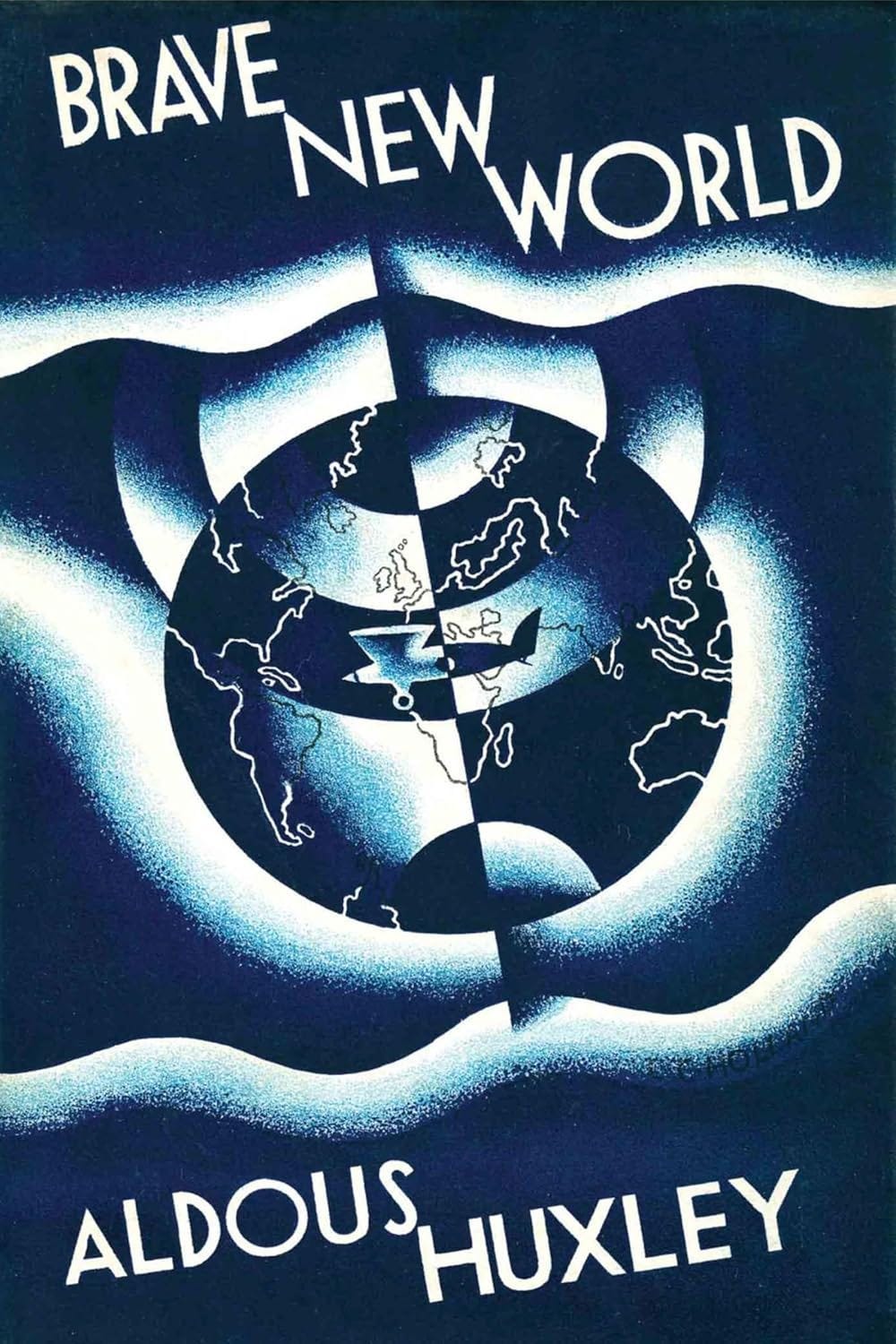
In these chapters we finally get some insight into the “Savage Reservation”, and it’s exactly what we would expect, the complete opposite of the World State in every way. We also meet John and his mother, Linda, the girl who the D.H.C. lost on his trip many years ago. The Savage Reservation and its inhabitants represent a stark contrast to the sterilized World State, and provide us with plenty to unpack.
Chapter 7
Malpais appears to be based on real landforms in the American Southwest, and is worth noting in its own right. It’s yet another example of the theme running through the novel that pits nature against the sterility of the World State
Lenina is shocked at the appearance of the Malpais inhabitants, “their dark bodies painted with white lines (‘like asphalt tennis courts,’ Lenina was later to explain)” — We’ve talked at length about the role of games in this world, but comparing indigenous body paint to lines on tennis courts reveals just how far their deranged conditioning really goes. The word “asphalt” is playing an important role here, too, further illustrating the World State as something manmade, unnatural by design (109)
“But how can they live like this?” Lenina asks about the dirt, the rubbish, the dust, the dogs, the flies—all of it. That’s the big question Huxley is gearing up to answer
“What’s the matter with him?” Lenina asks about the old, emaciated man. Even Bernard is startled by his appearance. He explains to Lenina that the World State keeps everybody young by preserving them from disease, transfusing young blood, etc. Sure sounds like utopia, doesn’t it? The treatment and elimination of disease is something society has always striven for, at least until recently But is it sensible to treat aging as just another fixable affliction? Is it human?
And there’s a catch: “Youth almost unimpaired till sixty, and then, crack! the end.” (111) Would you take that deal? It’s not exactly unappealing, especially as my thirties march onward and my hair continues thinning. But what is lost? Our whole grandparent era for one, playing bingo and crushing ice cream and saying racist shit and most importantly having grandchildren to spoil? Those days may seem distant to many of us, but they carry meaning. Is that why the World State has done away with the concept of motherhood altogether, because it clashes with their designs? (111)
This all points to our cultural fear of aging—the obsession with maintaining a youthful appearance. Botox, fillers, plastic surgery. Just look at the Kardashians. Or, tragically, Tom Brady. All the money in the world, all the success, and still that same fear: decay. Mortality. The World State exploits that fear, as all successful authoritarian regimes do. Not by confronting it—but by making you forget it’s happening at all
Bernard and Lenina witness women breastfeeding: “What a wonderfully intimate relationship…Often think one may have missed something in not having had a mother. And perhaps you’ve missed something in not being a mother, Lenina.” Generally speaking, no person in the world evokes stronger, warmer emotions than one’s own mother (sorry Dad). Conversely, losing one’s mother is one of the most devastating things we experience in life. You can’t feel strong, dangerous emotions about your mother if the concept of motherhood is erased altogether. The erasure of family is another form of sedation, shielding us from pain but also shielding us from love
To reframe this Tennyson/Tumblr style: “Tis better to have loved and lost than never to have loved at all.”
On page 113, Lenina witnesses the beginning of the sacrificial ritual: “Lenina liked the drums…it reminded her reassuringly of the synthetic noises made at Solidarity Services and Ford’s Day celebrations…the place was queer, so was the music…but the performance itself—there seemed nothing specially queer about that.” I really like this example because it shows the similarities between the two vastly different societies, how both of these societies utilize music and ritual as a means to shed their own individuality and find deeper meaning within the group, however misguided such meaning may be
It also speaks to the power of music in general—that Lenina simply “liked the drums” and didn’t find it queer makes me wonder if she would also like “Pink Pony Club.” Across time and across societies music is powerful—we’ve talked about that—yet we also witness how its community-building powers can be wielded to warp meaning and distort bonds instead of strengthening them
Not going to break down the wall of text on 114-115 that describes the ritual but this part stood out to me: “Then the old man lifted his hand and, startlingly, terrifyingly, there was absolute silence.” — Totally different context but it reminds me of Bernard and Lenina hovering over the ocean, where she needed to turn the radio on. Also speaks to silence in general—how in this world (and our own) it is something to be feared, to be distracted from, whether with a radio or an iPhone
The ritual in Malpais, however, ends with a sacrifice— “for the sake of the pueblo—to make the rain come and the corn grow" — Sacrificial rituals are something the World State would scoff at and so would we. Most of us think of some poor guy getting his blood spilled atop a Mayan temple in order to please the gods as a barbaric practice belonging firmly to the past. But the World State has sacrificial policies of its own. Sure, they’re not whipping people in the public square, but people are sacrificed in the name of prosperity every day. The World State takes this to an extreme, eliminating emotion and family and agency in order to make the worker as docile and productive as possible. We do it, too. Look at the union-busting of Amazon and Starbucks, the gig economy, the workers in California picking crops for pennies (Steinbeck sends his regards). Everywhere in this country—even our own jobs in which our raises are somehow lower and lower each year for the good of the shareholders—human dignity and well-being and individuality are sacrificed in the name of cheap production and mass consumption and, most importantly, profit. This extends to our beautiful planet and its stunning biodiversity, too—everyday plundered and polluted in the name of economic growth
We finally meet John, a white dude amongst the savages, who of course is also smitten with Lenina (thiccness — also universal) (117)
John is the one exclaiming how he wishes he could have been the one sacrificed—”to show that I’m a man.” Does bearing suffering prove one’s manhood?
Linda is John’s mother, and the same girl we witnessed the Director reflect on in previous pages. She’s alive! (118)
Regarding Tomakin/Thomas, the Director: “He must have flown away, back to the Other Place, away without her—a bad, unkind, unnatural man.” John’s assessment of the Director contrasts directly with the Director’s own telling of the story, in which he injured himself searching for Linda in the rain. It’s clear from his telling that he’s haunted by the painful memory. I wonder why John assumes he just left and not that he just wasn’t able to find her. Does he know the World State places no value in actual relationships, assumes the D.H.C. didn’t really care, and is therefore “unnatural”? Either way, this highlights again how conflict exists within even those highest up in the World State—a humanity that cannot be entirely repressed
We meet Linda on page 119, who Lenina also finds offensive, not just because she’s old but because she’s also fat—another image of ill-health and decay. Lenina is also put off by the stench of alcohol on her breath—even though Lenina herself was reaching for her soma just a page ago
Linda misses the old world—she’s overwhelmed by Lenina’s acetate silk clothes and velveteen shorts. Her whole introduction on pages 120-121 is basically a rehash of her conditioning—she strives for the sterile, stimulating world that she left behind, the soma, the sexual freedom of everybody belonging to everyone else—and the people of Malpais hate her for it
Linda is a distorted mirror to Lenina herself—she has the same impulses, the same beliefs, she is still a slave to her conditioning even after all of these years. Existing in a society that rejects such things, however, has made her an outsider, has made her grotesque
Yet even Linda is not entirely brainwashed. Having bore a son the natural way, she admits, “And yet John was a great comfort to him…I don’t know what I should have done without him.” Linda may still adhere to all that she was conditioned to believe, but having experienced motherhood, she is unable to reject it (122)

Chapter 8
This chapter begins with a deep dive into John’s upbringing
It’s interesting that John begins with an account of his mother attempting to reject sex from a stranger because her son is in the room. Obviously that would be the norm in our society, but for Linda, and her conditioning, it stands out that her motherly instincts are far stronger than her conditioning, that she sees something wrong with the situation, though she is eventually forced to give in (124)
Linda is a fish out of water in Malpais: “How should I know how to do their beastly weaving? Beastly savages.” More inversion here—the turning of craft into something obscene
The comparison between mescal and soma is made apparent. Linda says “it ought to be called soma; only it made you feel ill afterwards.” Throughout the novel the problem with alcohol, and the justification for soma, is that alcohol gives you a hangover and soma doesn’t. This intentional framing (by either the World State or Huxley) deliberately and revealingly ignores the true harm of such drugs, which is how they are used to bury emotion
Pope comes to see Linda often, always bringing mescal, always trying to Netflix and Chill. But Linda has other men, too, which causes the women of Malpais to break into her home and whip her for sleeping with their men. This is an early source of trauma for John, who asks her, “But why did they want to hurt you, Linda?” It’s perhaps the first inkling that he and his mother are different, that they are somehow outside of the society in which they live, just like Bernard and Helmholtz (126)
Linda blames John for her fate: “Turned into a savage…Having young ones like an animal…I might have got away. But not with a baby. That would have been too shameful.” We know that Linda later claims John helped her grapple with her own alienation and discomfort—so this early memory suggests development on her part, a shift in perspective facilitated by her own experience with motherhood
Linda describes “The Other Place” to her son as a positive utopia, where you can go flying “whenever you like.” Its scientific wonders disguise the degradation of the soul that made such a place possible, not unlike how Cinderella’s Castle masks the three-hour lines, the oppressive heat, the stifling crowds, and the maniacs on scooters running over your toes…Utopia in image, wallet-emptying apparatus in reality
She also tells John of “people never lonely, but living together and being so jolly and happy, like the summer dances here in Malpais, but much happier, and the happiness being there every day, every day…” An acknowledgement of happiness existing in the World State, an acknowledgement of dance as human and humanizing, as acts of community. It also raises a point about happiness: can it be so rich if it’s a constant? If prom were every weekend, would it be so special? (128)
The bottom of page 128 goes into detail about the faith of the pueblo, which is a bit muddled to say the least, but I think that’s the point, to show these people as human, as trying to make sense of their purpose and identity, as opposed to the World State which forces upon them a single view in which an industrial titan has replaced God.
Also worth noting that one of the pueblo’s stories regards Etsanatlehi, “the woman who makes herself young again,” — a clear indicator that the human impulse to reject time and aging exists across societies, an impulse exploited by the World State
Linda teaches John to read but it’s a World State science book, The Chemical and Bacteriological Conditioning of the Embryo...and he struggles to even read the title. “Beastly book,” John calls it, just as his mother calls weaving the same. Two important aspects of human nature, reading and craft, are thus linked with savagery and denied any importance or significance, not because they lack it but because they are not understood (129)
John is bullied because of his rags. He finds solace in telling himself, “But I can read and they can’t.” Reading as an act of resistance and strength, knowledge as power
John can read the words but doesn’t understand what they actually mean. This is a reflection of Helmholtz, who writes the words but realizes that they actually lack meaning
This is further dissected in his discussion with Linda about the origins of chemicals, who understands what they do but does not actual science behind them. John finds the answers of the old men of the pueblo to be more “definite”, although theirs are rooted in religion and are just as wrong. It’s a notable contrast. The world in which Linda was raised knows the answer to the origin of chemicals, but has compartmentalized knowledge so completely that Linda is clueless about them, as it wasn’t her job. The men of the pueblo, on the other hand, examine the world not through science but religion. The true answer about the origins of chemicals would prove existentially shattering to the people of both societies (130)
Pope gives John a copy of The Complete Works of William Shakespeare, which is banned in the World State. This is a major moment. It’s not an inaccessible science book but literature. If you’re reading The Great American Book Club, I’m sure you understand why this is a big fucking deal
(Disclaimer: I have an English degree but am by no means a Shakespeare scholar. I also have a set of his complete works on my bookshelf like the pretentious mfer I am but have not read them all. I’ve done my research about all the relevant quotes in Brave New World but my analysis likely lacks depth in many cases, so if you’re a Shakespeare stan, please comment about anything I’ve missed)
The first quote John reads is from Hamlet, and the words immediately speak to him: “The strange words rolled through his mind; rumbled, like the drums at the summer dances, if the drums could have spoken.” It’s an immediate assertion of the power of literature—the translation of sensations only felt, like music, into something more concrete, the grounding of human experience in words
More importantly John understands this passage from Hamlet in the context of his own mother, her drunkenness and salaciousness. Hamlet was written in a different time about different people, but its themes are universal, and therein lies its power, “a terrible beautiful magic” indeed (132)
I’m not totally sure why the words make John hate Pope even more. I think it might have to do with how the words allow John to articulate villainy in a way he hadn’t before. Shakespeare allows John to name the drunkenness and lechery that bother him so much with regards to his mother and Pope. Yet at the same time, because he doesn’t have a total grasp on the literature, he naturally applies the qualities of the King to the person in his life who most makes him uncomfortable
Because honestly Pope seems pretty chill. I mean he’s the one who gave John the works of Shakespeare to begin with, that’s real. He doesn’t even react to John stabbing him with anger—he actually bursts out laughing, and even calls John brave. He is wise, understanding, and forgiving
On page 134 John recounts old Mitsima teaching him how to work the clay. Earlier Linda struggled to weave baskets, calling them beastly, but here John admits “to fashion, to give form, to feel his fingers gaining in skill and power—this gave him extraordinary pleasure.” It points to the importance of craft, of creation, and also culture. Those doing their jobs in the Brave New World like their jobs, too, but because they are conditioned too, not because it taps into the human impulse to create (134)
John also tells of the marriage ceremony he witnessed between Kothlu and Kiakime which is obviously not a thing in the World State and which his mother of course views as uncivilized. John was devastated because he “loved” Kiakime, though he was only sixteen. His experience of what is most likely a “high school crush” is one that could never be in the Other Place. Teenage longing, yet another casualty of utopia (135)
He is also denied the rite of passage in the Antelope Kiva, where boys enter and emerge as men. “Not for the son of the she-dog,” the children exclaim, and pelt him with stones. “He was all alone.” The most heartbreaking characterization yet of John as an outsider, John as alien (136)
John does not cry because of the pain of the cuts and bruises but because “He was all alone, because he had been driven out, alone, into this skeleton world of rocks and moonlight.” Physical pain is second to the mental anguish John experiences due to his rejection from the community—loneliness is cast as the most serious of afflictions
“To-morrow and to-morrow and to-morrow.” Hand up I did not catch this Macbeth reference because I’m a Macbeth fan but because it’s referenced in the song “Take a Break” in Hamilton but it’s a beautiful, enduring passage that is worth quoting in full:
Tomorrow, and tomorrow, and tomorrow,
Creeps in this petty pace from day to day,
To the last syllable of recorded time;
And all our yesterdays have lighted fools
The way to dusty death. Out, out, brief candle!
Life's but a walking shadow, a poor player,
That struts and frets his hour upon the stage,
And then is heard no more. It is a tale
Told by an idiot, full of sound and fury,
Signifying nothing.
Do we think Huxley is claiming this nihilistic worldview, or working against it?
This quote is also used for the title of William Faulkner’s The Sound and the Fury which I just briefly considered including in the book club at some point before realizing that would be insanity. If you’ve attempted even just the first chapter you’ll understand why. Good book though
“He had discovered Time and Death and God.” Did he only discover these concepts because of his bleeding, because of his rejection, because of his suffering? (137)
John is surprised that Bernard admits to also being lonely. he says, “I thought that in the Other Place…I mean, Linda always said that nobody was ever alone there.” The Other Place is not lonely in terms of physical touch and social interaction but it is a manufactured form of community, one that doesn’t allow true connection, true emotion, or true loss. If you crave something deeper, like Bernard, you will be just as lonely as John
“I stood out against a rock in the middle of the day, in summer, with my arms out, like Jesus on the Cross…I wanted to know what it was like being crucified.” John tells Bernard, which should set off our Christ figure alarm bells. Bernard responds, “It seems a funny way of curing your unhappiness,” but goes on to think there might be some sense in it, that it’s better than taking soma. Is it better to bear suffering instead of running from it? Is that why the story of Jesus has such unparalleled staying power in our world?
And here we go. Bernard is going to bring John to London. It’s what the whole book has been leading up to, and it’s setting us up for an epic clash
John, of course, responds to the news by quoting The Tempest: “O wonder! How many goodly creatures are there here! How beauteous mankind is…O brave new world that has such people in it. Let’s start at once.” Poor guy. He has no idea.
Chapter 9
Lenina responds to the horrors of Malpais with an eighteen-hour holiday. That’s a strong ass gummy. But it’s a proportionate response to the magnitude of what she witnessed, and how impossible it is to reconcile with her conception of the world (140)
It’s fascinating that Mond views the return of Linda and John to London as a matter of “sufficient scientific interest”— they’re not viewed as humans returning home but as commodities to be further studies and dissected. It’s a clinical gaze, not a humanist one (141)
John breaking into the bedroom is a weird move, not gonna lie. His experience of Lenina’s slippers and and perfumes I believe is supposed to point to the tactile irresistibility of the World State’s products to the average human, and Lenina herself is an extension of this engineered seduction. But breaking into a woman’s room and inhaling her perfumes is never a good look
While observing Lenina he quotes more Shakespeare, Troilus and Cressida, and then Romeo and Juliet—both of these passages notably emphasize the whiteness of the women’s hands. I haven’t read Troilus and Cressida, so much of this significance is probably lost on me. Yet the importance of white as a symbol of purity and innocence is an obvious one, two attributes that do not apply whatsoever to Lenina. My reading of this is that John is romanticizing a person who he barely knows based only on her beauty, and his knowledge of Shakespeare is infusing his lust for her with a meaning that might not actually exist. In other words, he’s putting the pussy on a pedestal. I suppose we will see how that turns out.
So here we go. John and Linda going to London. In a way the whole first half of the book has been set up for this moment. We’ve met the important characters and witnessed their internal struggles, we’ve seen the irreconcilable differences between the Savage Reservation and the World State, and now we have John and Linda, aliens in their own community, returning to Linda’s former home, also as outsiders. I have a bad feeling about all of this.
Let’s keep reading.
Our next reading section for Brave New World will be chapters 10-12 and will be posted on Tuesday, May 6. It’s about 40 pages. I’ll see you guys then.
Steve