
Brave New World: Discussion I
Chapters 1-3: Community, Identity, Stability

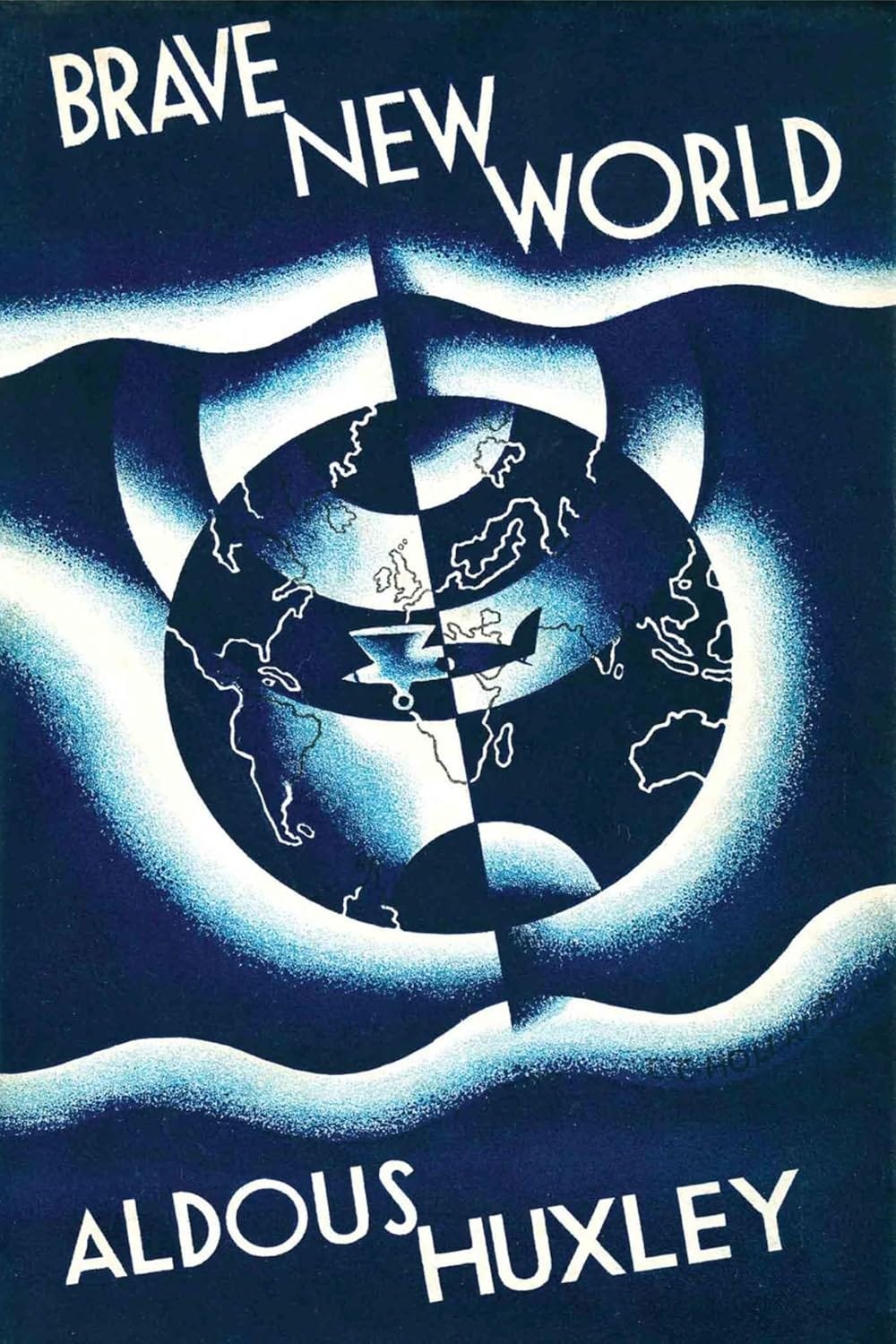
Epigraph
We didn’t talk about the epigraph in the beginning of Slaughterhouse-Five and it ended up being directly referenced so I guess we will give it a shot here. I hate to begin the discussion by breaking down a long-ass French quote but we have to do this baby justice. Here’s the translation of the quote:
Utopias appear to be a good deal more realizable than was previously thought. And today we are faced with an alarming question of a different nature: How to avoid their complete realization? Utopias are realizable. Life moves towards utopias. And perhaps a new century is beginning, a century when intellectuals and the cultured class will dream of ways of avoiding utopias and of returning to a non-utopic society, less "perfect" and more "free."
Yeah, so, anyone got any thoughts on this? In 2025 it’s hard to deny that life moves toward utopias. I mean just look at ChatGPT, for example, churning out high school and college essays. The suggestion here, though, is that something is lost in a perfect world which, in my poor example, would be students’ critical reading and writing skills. So maybe we should open this read with the question: what is lost?
Chapter 1
The novel begins with a description of a “squat grey building of only thirty-four stories” — the Central London Hatchery and Conditioning center. We’re immediately presented with an image of something drab, dreary, absent of any color or vibrancy. Just the simple choice of gray here really his sets the tone for the whole book, which sounds like it will be an uplifting read
COMMUNITY, IDENTITY, STABILITY. This is the World State’s motto. I mean who doesn’t want that? Enjoying the support of people around you, knowing who you are, living in a stable (and safe) society. Sounds pretty damn close to the American dream to me. But of course this is a dystopia, so we have to wonder: does the World State’s definition of those three words match our own? It’s no different from the “Great” in Make America Great Again. It all depends on what your definition of “greatness” is.
The description of the room on the ground floor further contributes to the illustration of the building as a place hostile to life: a sanitized, sterile laboratory where “wintriness responds to wintriness.” The light is “frozen, dead, a ghost” and even the workers even the workers inside are linked to this deathly atmosphere by their “corpse-coloured” gloves. The only “rich and living” substance is beneath the microscopes, suggesting the lab workers have somehow lost something essential to life
The substance beneath the microscope is compared to butter, an interesting word choice considering butter’s status as a particularly human product and indulgence, and a bit of a jarring contrast compared to the cold and bleak room. I went from deep uneasiness to wanting waffles real quick, and I think that’s exactly what Huxley intended.
So it’s a fertilizing room. That makes total sense, considering the lifelessness of it all. The author’s word choice tells us all we need to know what he thinks about this place. That he’s working against nature is already clear (1)
The Director tells the students about the workers in the hatchery: “For of course some sort of general idea they must have, if they were to do their work intelligently—though as little of one, if they were to be good and happy members of society, as possible.” He goes on to say that “not philosophers but fretsawyers and stamp collectors compose the backbone of society.” In other words, workers must know enough to do their jobs but not enough to philosophize, to question the system.
Questioning the system — The Great American Book Club is now batting 1.000 with that theme. Seems important.
A central theme in both The Grapes of Wrath and Slaughterhouse-Five was the danger in questioning the powers that be, whether the bank or the bomb-droppers. One was dealt with by the police, the other by denial, fatalism, and Tralfamadorian detachment. How will those questions be dealt with here? (4)
The Director is described as ageless—he could be old or young, thirty or fifty-five. Notably it’s not a question that people ask in the year A.F. 632, “in this year of stability.” Whatever and wherever this society is (A.F.?) in time, it seems to have solved the “problem” of aging. We’re also given our first insight into the concept of “Stability” that the book opened with. You or I would likely define stability as something like existing in a peaceful society and having access to food and water and medicine. But to the World State a core component of stability is the absence of aging (4)
“Begin at the beginning.” Stored sperm and ova, stored in the lab. The storage and processes are important for the world-building but more important here is the absence of human sexuality and connection that creates life
Bokanovsky’s Process— “Ninety-six humans out of one egg. Progress.” The mass production of fertilized eggs. Fantastic. It’s not just a rejection of human sexuality but of individualism which is, uh, concerning, based on what we witnessed in California and in Dresden. This is a dystopia, too, so buckle up.
That the touted process of bokanovskification is achieved in part by dousing the buds with alcohol is just a bit on the nose, but point taken
Obtaining eight to ninety-six embryos is described as “A prodigious improvement, you will agree, on nature,” and it’s hard not to throw up. It’s the mantra of capitalism applied to biological man and it's chilling in its implication. Bodies as commodities. If only Meg thee Stallion would relay that message to the world. (7)
“Identical twins—but not in piddling twos and threes as in the old viviparous days…” Viviparous = (of an animal) bringing forth live young that have developed inside the body of the parent. So in this society it seems the days of women bearing children are gone altogether.
Bokanovsky’s Process is “one of the major instruments of social stability.” So we have the absence of aging (likely coupled with absence of illness and possibly death) informing our definition of stability, and here is another: uniformity. Again, to me stability is going to Market Basket, buying bread and ice cream, and being astounded by the variety of idiots who don’t know how to maneuver a shopping cart. In the World State it means identical people, which may result in more efficient shopping but also everybody selecting the same gallon of ice cream, so I’m not sure which world is worse, here.
“You really know where you are. For the first time in history.” What do we think this means? It’s followed by the Director quoting “planetary” model of “Community, Identity, Stability” once more. How does knowing “where you are” contribute to these concepts. Could it be about purpose, or the absence of it? (7)
“The principle of mass production at last applied to biology.” What could go wrong with that?
Freemartins — they’re structurally normal, guaranteed sterile, but with the “slightest tendency to grow beards” — seem to be a middle ground between male and female, but I’m not quite sure what that means with regard to the plot. I’m tempted to make a woke joke here, but that would be too easy
The babies are predestined and conditioned, as “socialized human beings, as Alphas or Epsilons, as future sewage workers…” It’s intriguing to view this form of “predestination” alongside the determinism of the Tralfamadorians in Slaughterhouse-Five. While one adoption of this philosophy is scientific and the other psychological, their function is the same: the erasure of discomfort and conflict—the creation of a moral order that is difficult if not impossible to question, and therefore a form of “stability” but at cost of individuality, freedom, and ultimately truth (13)
It appears both the World controllers and Directors of Hatcheries are “Alphas” and we find out in a few pages that the students are, too. I’m wondering how much of this world is inhabited by these Alphas
“Nothing like oxygen shortage to keep an embryo below par” — what appears to be the central theme spelled out in scientific language, the justified and deliberate stunting of human growth in the name of progress and stability (14)
Epsilons don’t need and aren’t given human intelligence—they appear to be the lowest of the low (15)
The deranged logic of the World State even extends to reproduction. In Mombasa they produced individuals who were “sexually mature at four and full-grown at six and a half…but socially useless…too stupid to do even Epsilon work.” They were still trying to find the ideal compromise between adults of twenty and adults of six.” The insatiable appetite of capitalism at last applied to the human body, one that necessitates that childhood itself is viewed as superflous. It’s the same logic driving the attempt to remove child labor laws in some American states taken to the extreme—the logic of production, consumption, and shareholder value. Overnights on a school night? What’s the harm in that? (15)
“That is the secret of happiness and virtue—liking what you’ve got to do.” What do we think of this? It’s hard to wholly reject. If my job was something I liked and believed in like hitting home runs for the Red Sox I’m sure I’d be happy and virtuous—but the problem here is the World State decides what it is a person has “got to do”(16). We’re also relying on their definition of “happiness and virtue,” too
“All conditioning aims at that: making people like their unescapable social destiny.” The World State has engineered destiny and the acceptance of it. Dystopia at its finest. But what does this dystopia tell us about the real world we inhabit? Since we read The Grapes of Wrath, I can’t help but view the concept of social destiny as a tool of oppression in and of itself, however woke that may sound, in that it absolves us of responsibility for the fates of those left behind. “It’s not us, it’s the Bank” says the representative booting the farmers off of their land. It’s simply how the world is naturally structured: a world of rich and poor, of winners and losers, of economic forces that we are beyond our control. (16)
We meet Lenina, a nurse: “For all the lupus and purple eyes, she was uncommonly pretty.” Really bro
“Alpha Plus intellectuals” —Alpha Plus. It’s kind of giving Mew-Two. Apparently these are the real big swinging dicks of the World State
The Decanting Room — seems important, considering the chapter ended with it
Chapter 2
The nursery is a stark contrast from the laboratory at the beginning of the novel—a place “bright and sunny” as opposed to the one in which a “harsh thin light” glares. The nursery is a place of actual human life—for which sunlight is everything (19)
Huxley dedicates a whole paragraph to the description of the flower petals, and it’s refreshing. Of course he goes on to subvert it two pages later but in the moment the assertion and appreciation of nature is there, and that’s no doubt intentional
As the sun shines into the room: “The roses flamed up as though with a sudden passion from within; a new and profound significance seemed to suffuse the shining pages of the books.” An assertion of passion and meaning and knowledge. Glimmers of humanity. (20)
We’re all familiar with Pavlov’s dogs—so I don’t have to spell this one out for you. I also don’t really know what else to say about the babies treatment than wow that was some fucked up shit
“They’ll be safe from books and botany all their lives.” Lol. A cheeky line. But a damn good indicator of what we should be paying attention to (22)
The student “could see quite well why you couldn’t have lower-caste people wasting the Community’s time over books…yet…well, he couldn’t understand about the flowers.” (22)
The D.H.C. tells the student people were once conditioned to like flowers so that they would go out to the country and “consume transport.” That transport is something that is consumed sounds like a strange idea, but it is something we consume. Just look at the airlines raking in billions, and still charging us to select a seat
But why did the consumption of nature change? It changed because “primroses and landscapes…have one grave defect: they are gratuitous. A love of nature keeps no factories busy.” And there is the logic of capitalism, the logic of extraction, laid bare. Everything must turn a profit, and there is no value in that which doesn’t, no matter how beautiful. Everything must be commodified in some way; everything must be perceived through the lens of ever-increasing profit. This isn’t dystopian British logic either—it’s the logic of our current administration, for whom the beauty and biodiversity of our National Forests and National Parks is not enough: “Under the pretense of national security, the president’s orders aim to gut environmental safeguards and fast-track industrial clearcutting in some of the US’s most precious and climate-critical forests.” (The Atlantic)
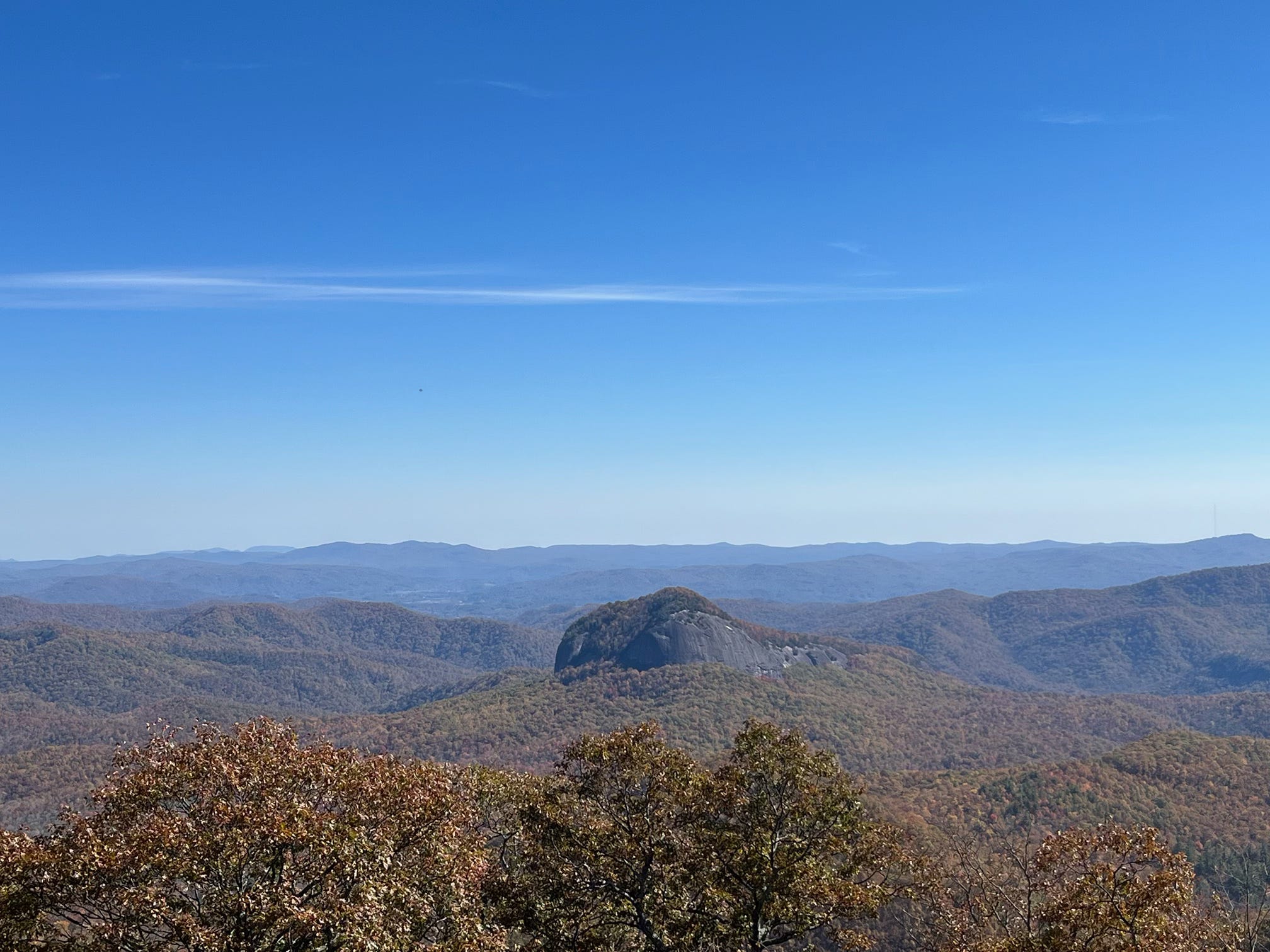
The above is one of the best hikes I’ve ever done, Looking Glass Rock, in Pisgah National Forest in the Blue Ridge Mountains of North Carolina. When we finally got to the top of the rock and looked out, all I could think was “look at all that wasted timber.”
To its credit, we have no indication (at least so far) that the World State is simply plundering nature for resources (they def are). They don’t want to stop the tendency of people to “consume” transport but they need an explanation “economically sounder” than primroses and landscapes
So what is the solution to keep people going to the country? Conditioning them all to like country sports that use an “elaborate apparatus” to keep them consuming “manufactured articles as well as transport.” (23) I can’t help view this through the lens of—you guessed it—the NFL
I work next to Gillette Stadium, and on game days when I’m sitting in miles and miles of traffic it always strikes me how stupid it all seems. These people driving out here from across New England just to watch what amounts to an hour of actual action. A million cars, a million cops screaming at them, all for a game
For the NFL, it’s not enough to just buy a ticket to the game or to have it on your television. The commercials are insufficient. You need to have the throwback and Color Rush jerseys, the Bud Lights, the knitted hats and hoodies, the survivor pool and the fantasy team and the five-leg parlay, the Tik Tok clips and the buffalo wings. Sure seems like an “elaborate apparatus” to me
And the question I think that Brave New World wants us to ask is why is this how we spend our Sundays? Why do we spend a day off getting drunk and overeating and losing bets and raging as we watch Mahomes fake run out-of-bounds yet again. Why not spend our Sundays down the street from the stadium at the state forest instead, taking in the tranquility?
I like football, I swear. It’s just too easy.
“Our Ford” — This is the first time we see Ford used in place of “God” in the novel, and I don’t want to dive too deeply into what this might mean just yet. But it’s important for to note that in this society an industrialist has replaced God, and industry has replaced religion
Polish, French, and German are dead languages — this gives us more insight into the world, a place where difference and therefore culture has been eradicated. It’s more uniformity, and in turn, stability. But it’s stability at the cost of Identity, another core tenet of the Word State’s motto. How do they reconcile that? With a different definition of identity that is biological instead of cultural (23)
Sooo…not only do women not bear children, it seems like the concept and practice of parenthood has been erased from society altogether.
“The smut that was really science fell with a crash into the boys’ eye-avoiding silence.” — This hints that sex and “smut” still exist, but they’re wholly detached from their scientific or natural purpose. Has sex been reduced to only pleasure?
Why is George Bernard Shaw “one of the few whose works have been permitted to come down to us”? I don’t know enough about him to venture a guess. Anyone got something? (24)
Sleep-teaching — Those subjected to it can remember the words, but they don’t understand what the words mean. They can repeat facts but they don’t actually understand them. An apt metaphor for the internet age
Students are alphas, but they are still “well-conditioned.” Are all Alphas still conditioned. Does any person of tier of people in this society exist that hasn’t been conditioned at all?
The “Elementary Class Consciousness” class is the instrument with which the World State exercises control. Although dystopian in nature, it parallels the very real experience of growing up in a society stratified by class. We absorb the things we hear, from our family and friends and media, and this informs how we perceive the world, how we perceive those we deem beneath us (27)
The sleep-teaching also can be connected to the internet today — how we don’t necessarily believe what is true, but what we see repeatedly. What would Huxley have to say about the age of the algorithm?
Epsilons are still worse — Interesting how even in this society which claims to have it all figured out there still needs to be a bottom caste, one beneath all of the others. Why is that the case?
Words without reason — the greatest moralizing and socializing force of all time
Chapter 3
Chapter 3 opens with a description of a garden in which children play. The roses, the nightingale, the cuckoo provide another natural contrast to the dreariness and lifelessness of the World State, another fleeting illustration of life
The Director muses how games used to be played with mostly just a ball and some netting, but now the Controllers would never approve of a game without a complicated “apparatus”. We touched upon this already, but it’s worth noting again as it provides insight to the dynamics of society and the power of the Controllers. That soccer and basketball would not be approved by the Controllers tells us a lot
Erotic play between children is normalized. Definitely one of the weirder aspects of the book, but it tracks with what we’ve seen already: the speeding up and suppression of childhood
Most people in Ford’s day weren’t having sex until after 20 years old. A society of loser virgins in their twenties doesn’t exactly seem to be healthy, either, but the Word State’s answer to that—children “frolicking” in the garden—seems like a gross overcorrection (33)
His fordship, Mustapha Mond — The Resident Controller for Western Europe, a dark and authoritative kind of guy, Snape-like, firm in his convictions
Mond’s words are described as “straight from the mouth of Ford himself.” In a society in which Ford is God, the Controllers take on a religious significance, the same divine authority rulers throughout history have wielded. How do you question the words of somebody who speaks for God (or Ford) himself?
“History is bunk.” A quote from Our Ford. This suggests a society that believes it’s beyond the forces of history, that the lessons of history do not apply to it, and are not worth paying attention to. It’s an essential authoritarian creed (34)
Mond whisks away with his hand Babylon and Odysseus and Job, Athens, Rome, and Jerusalem, cathedrals, King Lear, and the Passion. It’s not just rejection of these key symbols of human civilization and flourishing—it’s disdain for them. Historical and architectural wonders like Rome and Athens described as “ancient dirt.” Odysseus and King Lear rendered irrelevant. Religion and worship and the Passion of Christ written off as worthless. History is bunk. What threat do these symbols of human civilization represent to the World State? (35)
The Feelies — seems to be like the movies, but with…touch?
As Mond talks to the students about history, the Director thinks about the rumors of forbidden books in Mond’s study: Bibles and poetry. Blatant hypocrisy if true, but Mond no doubt has a justification for it
“Mother” is a “smutty” word. The students have no concept of home. It’s clear that much of the World State’s power is derived from its total severance of the population from that which makes them human, and their ability through various means to convince the people that this is the norm. A rejection of the natural order of things in the name of stability, in the name of control, yet at the cost of one of the most innermost aspects of one’s identity—his family (36)
Mond describes a mother’s cooing over her baby as something to induce a “shudder”— even motherly instinct is turned on its head (38)
It’s interesting to compare the World State’s dogma with that of Steinbeck — In his work, the ultimate source of strength and solidarity for downtrodden people like the Joads was family. It makes sense why the World State would want to erase that, but damn that is bleak
Not exactly sure what a pregnancy substitute is, but I assume these drugs that Lenina and her friend take mimic the effects of pregnancy, since women no longer give birth. Seems just a bit unnatural but hey, stability
“Our Ford—or Our Freud…he chose to call himself whenever he spoke of psychological matters…” So Freud and sex appear to be the psychological counterpart to Ford and his industry, which must partly explain the whole garden scene. Is the World State governed by mass production and pleasure? (39)
Fathers = misery; mother = perversion; siblings, aunt, uncles = madness and suicide. It’s insane how the World State has took the pain and difficulty that exists within families, and turned it into an argument for the abolishment of the family altogether
“And yet, among the savages of Samoa, in certain islands off the coast of New Guinea…” I wonder what Mond’s definition of “savage” is (39)
Lenina’s consistent dating of Henry Foster is viewed by her friend, Fanny, as shocking. It’s that same inversion of normal human experience that we see throughout the text. Four months of Henry Foster! The horror! Mond sums up why: “Family, monogamy, romance. Everywhere exclusiveness, a narrow channeling of impulse and energy.”
“But everyone belongs to everyone else,” a hyponpaedic proverb that results in everyone just banging everyone else. You don’t even have to try to get laid in the World State. The second pillar of their motto is Community, and what is more communal than everybody fucking everybody else? I mean I was thinking more along the lines of a farmer’s market but that really is the quintessential example (40)
Emotions are the opposite of stability, and what aspects of life channel the strongest emotions? Our relationships. With our parents, with our siblings, with our boyfriends and girlfriends. The World State’s power is predicated on the erasure of emotions, the erasure of pain, in the name of stability—strong emotions lead to conflict, and must be avoided
“Wheels must turn steadily, but cannot turn untended. There must be men to tend them, men as steady as the wheels upon their axles, sane men, obedient men, stable in contentment.” It’s tied back to production here, too, suggesting that the World State’s motives—its battle against suffering—is not primarily humanist but economic
On page 41, “their world didn’t allow them to take things easily, didn’t allow them to be sane, virtuous, happy.” We questioned the definitions of virtue and happiness above, and we were right to. Because it’s not about true virtue or happiness, it’s about not caring enough to become upset
“Crying: My baby, my mother, my only, only love; groaning: My sin, my terrible God; screaming with pain, muttering with fever, bemoaning old age and poverty—how can they tend the wheels?” Note the justification for the erasure of pain is not a rebuke of suffering itself, but a rebuke of how suffering makes human beings less productive (42)
Bernard Marx doesn’t like Obstacle Golf and spends his time by himself. What a freak. He hates how the other guys talk about Lenina as if she’s a piece of meat. He’s a specialist in sleep-teaching, which is ironic. He seems like a decent guy.
“Sixty-two thousand four hundred repetitions make one truth.” The election was stolen. (47)
Lenina, with her odd dating habits and interest in Bernard, is someone out of step with her peers just as Bernard is, if not so drastically. Their characterizations show us that despite the World State’s control, not everyone succumbs it completely
“Has any of you ever encountered an insurmountable obstacle?” Mond asks the students, who all shake their heads no. Instant gratification is now the way of life—another way the World State has distorted and undermined the nature of time in the name of stability (45)
Huxley gets cute with the technique here, alternating between perspectives with short paragraphs, which is nice to read but annoying to write about.
There seems to have been a war, and chemical weapons, that led to an Economic Collapse—and it’s out of this horrible war that the choice emerged between “World Control and destruction. Between stability and…” The war killed liberalism (47)
“Ch₈C₆H₂(NO₂)₈ + Hg(CNO)₂ = well, what? An enormous hole in the ground, a pile of masonry…a foot, with a boot still on it, flying through the air and landing, glop in the middle of the geraniums—the scarlet ones; such a splendid show that summer!” A Tralfamadorian description if I’ve ever seen one, painting the weapon as a neutral chemical equation, the detached way it speaks about a man’s severed foot. If the Joads response to suffering was family and solidarity, and Billy Pilgrim’s response to suffering was fatalism, then the World State’s response to suffering is totalitarianism—to do away with the emotions that cause such suffering in the first place (48)
That being said, I feel like the Big Ten Controllers obviously exploited the horrors of war for their own gain. They convinced people to give up their liberties in the name of stability, in the name of safety. Scared people will give up anything. Patriot Act, anyone?
The new world order after the war compelled everybody to “consume so much a year. In the interests of industry.” There were mass protests. “Anything not to consume. Back to nature.” This serves as a reinforcement of points touched upon earlier with regards to nature and functions as an assertion of its righteousness. Man should be consuming nature, not goods. He should be hiking in the state park not screaming at his television that the NFL is rigged. This history that the Controller relays so dispassionately is actually an assertion of human dignity, just like the labor strikes in Steinbeck, and that is why in the World State claims “history is bunk.” (49)
The mantra of consumption is repeated in the sleep center: “I do love flying, I do love having new clothes.” And later: “Ending is better than mending.” Why get your iPhone with the cracked screen fixed when the iPhone 37 is releasing this October with an even better camera? “The more stitches, the less riches.” (49)
“You can’t consume much if you sit still and read books.” THEME.
I’m curious how the Controllers were able to pull of an “intensive propaganda” against parents. I mean
“Accompanied by a campaign against the Past; by the closing of museums, the blowing up of historical monuments; by the suppression of all books published before A.F. 150.” That’s the playbook, guys. And it’s undeniable that it’s playing out right here, right now. The past is dangerous, because the past is the truth.
Fanny tells Lenina that her choices are going to get her into trouble. But they don’t grapple with it. Their conversation then devolves into talking about belts, just like the Controllers want (49-51)
The introduction of the new Ford T-Model is chosen to mark the beginning of the new era, another obvious example of industry as religion. Will the introduction of the Model S one day mark an era of our own?
No God anymore. Crosses with their tops lopped off, turned to Ts — the substitution of religion for an industrial creed. Undeniably clever (52)
Underconsumption is described as “positively a crime against society” in the “age of machines” — there is that familiar logic of mass production and mass profit that asserts itself as an inevitability, a force of nature in its own right like that of the Bank and the Tractor
“There was a thing called Heaven; but all the same they used to drink enormous quantities of alcohol.” (53)
Bernard hates the bros. Bernard craves human, individual connection (53)
Alcohol, morphia, cocaine…the Controller cites these former societal ills as justifications for the new world order which is eerily similar to how the current president ties everything to fentanyl—an obvious problem, but one that is exploited
Lenina as meat — a different take but not wholly disconnected from that of Steinbeck and Vonnegut, in that she is denied individualism, agency, and decency, just like Tom and just like Billy
Soma - The perfect drug. “Euphoric, narcotic, pleasantly hallucinant…all the advantages of Christianity and alcohol; none of their defects.” This is a more obvious symbol of the theme of sedation that we’ve been dancing around but haven’t yet named: the suppression of emotion is not just biological and social but also pharmaceutical
It’s interesting how soma is said to be free of defects, too. It might not inspire fanaticism or lead to a hangover but its proponents gloss over what some might consider the biggest defect of all: how it disconnects people from human experience
“And do remember that a gramme is better than a damn.” I’m surprised I haven’t seen this on a dispensary billboard yet, which have popped up all over the region. Reading Brave New World I can’t help but wonder about the impact the widespread marketing of this different type of sedative has on society, same with mobile sports gambling
Old age is the last thing the new world order needs to conquer, and they do: “the old men work, the old men copulate, the old men have no time, no leisure from pleasure, not a moment to sit down and think”—and if they do they can simply pop a soma.” Keeping them productive to the very end (55)
Keep them working, keep them high, and keep them fucking, and they won’t ever question anything
We’ve covered a lot here, and a lot of it wasn’t exactly subtle. The World State has built a controlling apparatus in the name of “stability,” but at the cost of both identity and community, which its motto claims to uphold. So much of what makes us human has been erased in the name of preventing suffering. It’s certainly dystopian, but there are hints that it will be questioned. Namely, Lenina and Bernard show us that there are cracks in the facade, flaws in the system, people who see the system for what it truly is. A reckoning is inevitable. I wonder what form such a confrontation will take.
As always, make sure you comment on whatever stood out to you in these first three chapters. Go off one of my talking points or post your own—we will go wherever the discussion takes us.
Our next discussion will be for chapters 4-6 and will be posted on Wednesday, April 16. It should be a good one.
Steve
Ugh. Can I start by saying I cannot get into this guy’s writing style. I’m sure it’s intentionally written to sound impersonal and scientific-adjacent because it’s the future and there’s no humanity there but it’s kind of missing the mark for me. Sorry to huxley heads.
The grey building reminds me of the banality of evil — evil takes place in the most mundane of ways, person by person just going about about their lives and working their insignificant jobs, but it all adds up to being part of a vast evil empire. Community, Identity, Stability — reminded me of the French motto equality, liberty, fraternity. The difference to me is the brave new world version seems to imply conformity to the caste system in order to create stability while the French motto was inspired by revolution and murdering/upending the elite system :)
Nature vs technology seems like a big theme - there is no way of reconciling these two concepts. It’s natural to have a family unit and feel connected to the outdoors but they need to moralize (without a god?) that it’s wrong and selfish.
I pulled the same quote: “That is the secret of happiness and virtue—liking what you’ve got to do. All conditioning aims at that: making people like their un-escapable social destiny.” There is a harsh caste system that creates order and forces people to be content.
You know I have to take some issue with the anti-communism. I get he’s trying to make a comment on the idea of a utopia. But Marx, Lenin, Trotsky were on to something. I can’t help but think huxley is actually critiquing capitalism — the need to consume and give up your body for work. Of course he makes Ford, daddy to American capitalism, the big guy. We’ll see where he goes.