
1984: Discussion III
Chapter 3: Loyalty, Desire, Lies

Chapter III
The chapter begins with Winston dreaming of his mother who, alongside his father, was evidently “swallowed up in one of the first great purges of the Fifties.” I wonder why. Were they simply guilty of Thoughtcrime, or were they actual rebels?
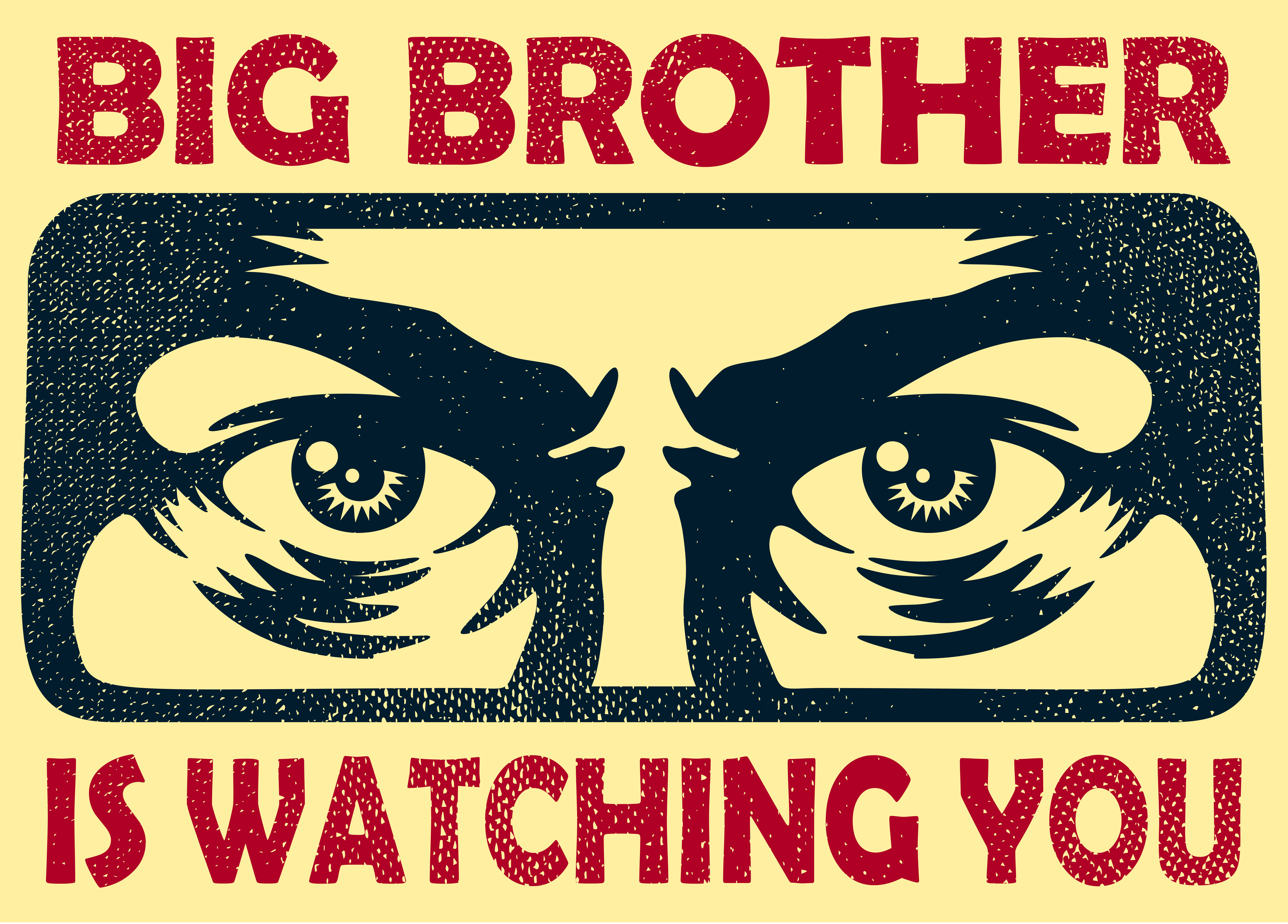
He only remembers his younger sister as a silent, feeble baby with large “watchful eyes”—an opposite image of Big Brother. He looks down at the individual, suspicious and penetrating—while the baby looks upward and outward at the world, an expression of helplessness, innocence, and innate possibility and wonder that Big Brother’s gaze tries so hard to extinguish
“He was out in the light and air while they were being sucked down to death, and they were down there because he was up here. There was no reproach either in their faces or in their hearts, only the knowledge that they must die in order that he might remain alive, and that this was part of the unavoidable order of things.” A big statement here, but does it reflect reality? Did Winston’s family literally sacrifice themselves for him? Is it a message propagated by the Party to divide the nation, the family, to spread a message that some must suffer so that others may live? Or is it more philosophical, a commentary on the “natural order” at large, the dog-eat-dog world? (29)
“Tragedy, he perceived, belonged to the ancient time, to a time when there were still privacy, love, and friendship, and when the members of a family stood by one another without needing to know the reason.” A grim portrait, but consistent with the one playing out. Tragedy implies connection and loss. It gives birth to devastation—and devastation invites outrage
In a world where the home, romances, and relationships—places wherein we develop our capacities to feel and express—have been invaded by Big Brother, tragedy becomes inconceivable, a relic of a more emotional time. There can be no tragedy when nothing matters. We can read the disappearance of “Mrs.” the same way—an anachronism no longer applying to the times, rendered neutral, its preconditions of marriage and womanhood dismantled, just like the preconditions of privacy, love, and friendship necessary for tragedy
Winston does not remember how his mother died, but does recall “she had sacrificed herself to a conception of loyalty that was private and unalterable...Today there were fear, hatred, and pain, but no dignity of emotion, or deep or complex sorrows.” (30) A couple things going on here:
Loyalty, it seems is incompatible with survival, and is something that the Party seeks to destroy. That Winston describes it as “unalterable and private” speaks to its potency: it’s an ideal, a conviction, a part of the mind that the Party, at least in his mother’s case, could not infiltrate. Of course, they opted to simply off his mother instead. That his mother’s act of selflessness has stayed with Winston testifies to the power of memory
Erasure of deep emotions—We saw this in Brave New World, too. Oceania eliminates complex emotions through constant surveillance and censorship, the suppression of private life. Emotions that cannot be expressed die out. The World State achieves the same goal through sedation, soma and sex and the feelies, the stimulation of the body which is always chosen over the stimulation of the mind
This is evident in our own lives, too—nowhere more than on social media. Can complex political questions or tragedy that were once grappled with in books be conveyed in a fifteen second clip? Songs are shorter. ChatGPT reads and writes for us. Netflix has discussed the need to reiterate the plot multiple times throughout their films, because people are dividing their attention between two screens. Fear, hatred, and pain are pushed by the algorithms because they’re primal emotions—easier to tap into. Reaction, not reflection, dominates our discourse.
Obviously these decisions that shape our media environment are economic rather than authoritarian in nature. But are they really so different? Whether by the hands of Party or Tik Tok, the reduction of complexity results in the same thing: the suppression of human nature, the shaping of the individual into a simpler form that more readily serves the interests of others, not himself
The Golden Country—a counterimage to cold London, an image of nature that’s as important as any we’ve seen in providing an alternative to the present reality, with elm trees whose leaves stir like “women’s hair.” Why does Orwell choose to link nature to women? (30)
“Her body was white and smooth, but it aroused no desire in him; indeed, he barely looked at it. What overwhelmed him in that instant was admiration for the gesture which which she had thrown her clothes aside.” An inversion here of the typical male gaze, considering most men would be far more interested in the body beneath the shirt than the flinging aside of the shirt itself. The removal of one’s clothes, an act of agency and freedom, holds more appeal to Winston than the female body itself
“With its grace and carelessness it seemed to annihilate a whole culture, a whole system of thought, as though Big Brother and the party and the Thought Police could all be swept into nothingness but a single splendid movement of the arm. That too was a gesture belonging to an ancient time.” Perhaps the most important line we’ve read so far, because it speaks not to the annihilation of the individual but the annihilation of the system that degrades him. The key to the Party’s defeat lay in a woman removing her shirt. How? Why is it so potent? What is contained in this gesture that makes it so impactful?
Disinhibition
Desire
Lust
Sexuality
Pleasure
Connection
Intimacy
Informality
Spontaneity
Individuality
Agency
Privacy
It’s a relationship between two human being unmediated by the doctrine of the Party, proof of a physical, emotional, and biological reality that it cannot fully suppress. Earlier we discussed the organized hikes, fundraisers, and demonstrations—outputs of human passion that were colonized and thus neutralized by the Party. The girl’s gesture distills those same human impulses to an interaction between man and woman, yet the meaning behind this interaction is harder for the state to eliminate. Sure, they have telescreens in the bedroom, and the Junior Anti-Sex League—which seeks to deny the sexual instinct altogether—but can they ever truly suppress the human need for touch?
The “Mrs.” and the tragic figure are consigned to history because the institutions that gave birth to them—marriage and the literary world—have been reduced in complexity. The notions of privacy, sacrifice, intimacy, and love necessary for these structures have been eliminated. So too is this gesture of sexual spontaneity described as “ancient”, but I want to push back on that. Sure, the missus was replaced by the comrade; Hamlet replaced by the violent war flick. Yet the fact that Winston dreams of this scenario at all testifies to its irrepressibility; you can replace social structures and literary forms with less radical formations—but how do you replace human desire? Is that the last unconquered territory of the Party?
We can read it more broadly, too: human connection as the antidote to Big Brother, because the “system of thought” that sustains it relies on our fear of one another: the child, the neighbor, the colleague, the foreigner
“Winston woke up with Shakespeare on his lips.” Interesting link to Brave New World, considering how in that novel Shakespeare comes to represent notions of truth and beauty that the World State believes to be dangerous in the hands of the people
“The Physical Jerks would begin in three minutes.” (31) Just as the Party compels shouting in the Two Minutes Hate, and standing at attention during “Oceania, Tis for Thee”, it also compels its members to exercise. Not ideological, but again the imposition of a physical reality. Later, on page 36, Winston is called out specifically by the instructor for not bending low enough. This dispels any notion that Big Brother is not actually not watching everyone all the time, or does not really care about each individual’s adherence to its program
“When there were no external records that you could refer to, even the outline of your own life lost its sharpness.” Disorientation again, this time more about personal remembrance than historical time, yet it speaks to the same effect. If a person can’t orient herself in her own life, if she can’t remember events or incidents or anniversaries, how can she possibly position herself against an entire apparatus? We resist domination because of who we are, because of the life we remember and cherish, but that starts with a sense of self, identity, the passage of time
“Though London, he felt certain, had always been called London.” Why has London has remained the same? I want to interpret it as the influence and history and personality of London being too strong to erase altogether, though it’s probably something more practical. It’s worth noting that Winston is sure of this, too. What is it about a city’s name that is harder to erase?
“…he was also suffering under some grief that was deep and unbearable. In his childish way Winston grasped that some terrible thing, something that was beyond forgiveness and could never be remedied, had just happened. Someone whom the old man loved, a little granddaughter perhaps, had been killed.” The tragedy of war, the nightmare of every parent, perhaps the very outcome Winston’s mother sought to avoid when she sacrificed herself to him (33)
“Since about that time, war had literally been continuous…but to trace out the history of the whole period, to say who was fighting whom at any given moment, would have been utterly impossible.” Continuous war means continuous vigilance, sacrifice, fear. The Enemy at the Gates is an animates the people to accept injustices they otherwise wouldn’t. Recall the Patriot Act.
Eurasia/Oceania—this is a big concept in the book that you’ve probably seen before. Winston knows the enemy has changed, alliances have shifted, but officially it has not and never has. What is the purpose of this? Is it disorientation again, meant to confuse the people, so they can no longer have any grasp on what is true, and so stop caring? It brings to mind these quotes from Hannah Arendt:
“The result of a consistent and total substitution of lies for factual truth is not that the lie will now be accepted as truth and truth be defamed as a lie, but that the sense by which we take our bearings in the real world—and the category of truth versus falsehood is among the mental means to this end—is being destroyed.”
“If everybody always lies to you, the consequence is not that you believe the lies, but rather that nobody believes anything any longer. This is because lies, by their very nature, have to be changed, and a lying government has constantly to rewrite its own history. On the receiving end you get not only one lie—a lie which you could go on for the rest of your days—but you get a great number of lies, depending on how the political wind blows. And a people that no longer can believe anything cannot make up its mind. It is deprived not only of its capacity to act but also of its capacity to think and to judge. And with such a people you can then do what you please.”
So is the point of lying about the wars not to make people believe the lie, but to engender confusion, then nihilism, and ultimately the withdrawal of the populace from political life? To not change the truth but dissolve its importance altogether? Could that be the strategy of our current president?
“The enemy of the moment always represented absolute evil, and it followed that any past or future agreement with him was impossible.” Maybe the wars never end because ending the war would be a concession, and ending the war would reduce the animating, uniting force of the terror that is Goldstein. A war with defined goals can be criticized, a war in which our own survival as a people is threatened cannot. It also seems orchestrated, however—how could this work if Eurasia and Oceania don’t go along with it, or is it all fake?
“The frightening thing…was that it all might be true. If the Party could thrust its hand into the past and say of this or that event, it never happened—that, surely, was more terrifying than mere torture or death.” The collapse of meaning, reality not as truth but as decree. Why is this more terrifying than torture or death?
“But where did that knowledge exist? Only in his own consciousness, which in any case must soon be annihilated. And if all others accepted the lie which the Party imposed—if all records told the same tale—then the lie passed into history and became truth.” All we have is written record. If that is corrupted, how can we know anything? If a lie passes into history, and that falsehood, later, goes on to dictate real-world interactions—however big or small—is it not then true? If the government of Massachusetts scrubbed all references to Dunkin’ Donuts and henceforth insisted that it only has ever been Dunkin’ and my kid grows up in a world of Dunkin’ with their scrawny donuts and lives his life believing it always been Dunkin' then isn’t that true to him? Or what of the soldier who goes to war over a lie, who fights for a lie and dies for a lie? What if his death leads to a great victory and the international order is rearranged in accordance with that lie for which he fought? If this belief defines reality, is it not then true? How else can we know truth, if not through the written record?
Reminds me of the saying, “History is written by the victors.” How many accounts of history have we grown up believing were tweaked, represented, even fabricated?
“Who controls the past, controls the future: who controls the present controls the past.” So the idea here is that those in power can exercise control over the past—over the narrative—and in doing so ensure their dominance in the future. Winston rejects this, noting that the past, like his mother’s conception of loyalty, is not alterable and never has been (34)
Doublethink: “An unending series of victories over your own conscious…to know and not to know, to be conscious of complete truthfulness while telling carefully constructed lies, to hold simultaneously two opinions which cancelled out knowing them to be contradictory and believing in both of them, to use logic against logic, to repudiate morality while laying claim to it, to believe that democracy was impossible and that the Party was the guardian of democracy, to forget whatever is was necessary to forget, then to draw it back into memory again at the moment when it was needed, and then to promptly forget it again, and above all, to apply the same process to the process to the process itself…” (35)
A comprehensive definition here, and I’m wondering how Doublethink has become so widespread. Is it the reality of living under totalitarianism, a defense mechanism against the unbearable, an act of self-preservation? Can you think of any examples of Doublethink in your own life, or in our current political discourse?
“For how could you establish even the most obvious fact when there existed no record outside your own memory?”
“Everything melted into mist.” A short line but telling: you can’t make out anything in the mist, where you are, who is beside you…
The Party claims to have invented airplanes. This one just made me lol.
Winston not being able to touch his toes could be read as a metaphor of the Party’s failure to fully master him. However, at him touching his toes at the end of the chapter “for the first time in several years” at the Party’s bidding—after all of his revolutionary thoughts—could be seen as a dark bit of foreshadowing
That completes the notes for chapter three. We’ve covered a lot here: memory, loyalty, desire, truth—and the story has only just begun. Please comment below with any of your observations. They can riff off any of my points or can say something completely new, since I’m sure I overlooked many things.
Our next discussion will be posted on Tuesday, 2/10 for chapters 4-5.
Keep reading.
Steve