
1984: Discussion II
Chapter 2: Invasion, Indoctrination, Isolation

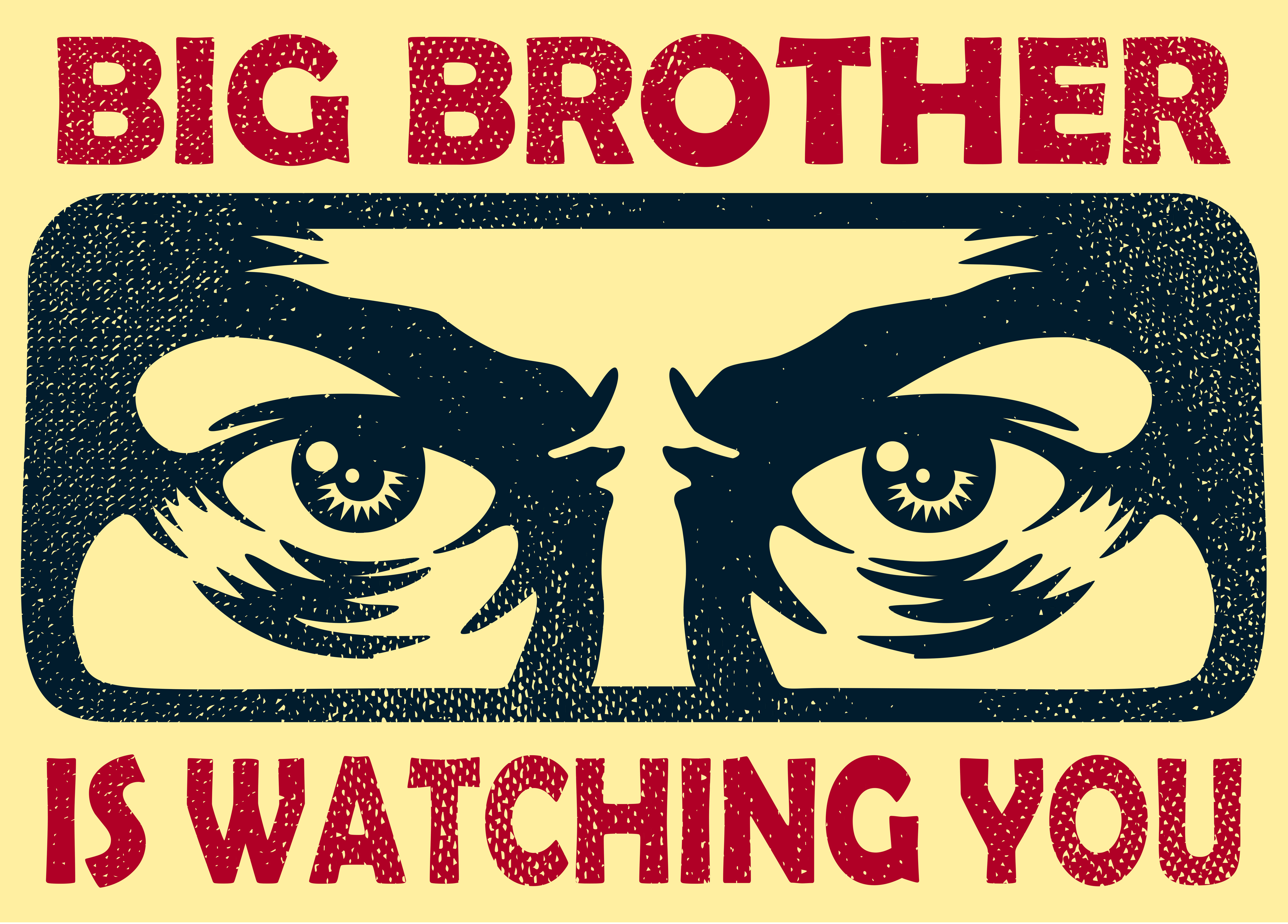
“He didn’t want to smudge the creamy paper by shutting the book when the ink was wet.” It’s not just the act of writing, but having something written—maybe having something to read—that matters, too. Winston wasn’t just venting, getting it off his chest. He was recording it for posterity—staking his place in time—and by doing so imagining a different possible world. Recall how it’s not the written phrase “DOWN WITH BIG BROTHER” that carries the significance or the death sentence, but the act of writing itself that is revolutionary. Writing is an act of agency and thought; writing is an expression of time, place, experience—in other words, truth (20)
Mrs. Parsons—“A colourless, crushed looking woman, with wispy hair and a lined face, was standing outside.” Winston experiences relief at the appearance of his neighbor instead of the Thought Police, but her appearance isn’t exactly an encouraging one either. Weathered, drained of color and vitality, she’s a different image of suffering and condemnation. It’s a safe bet her destitution stems at least in part from the state. And she’s only thirty???
“One had the impression there was dust in the creases of her face.” We clocked this in the first paragraph of the novel, the “swirling dust” that swept into the room after Winston, and it was mentioned on a page later, in the streets, where “little eddies were whirling dust and torn paper into little spirals.” I’m curious about this invasive, inescapable dust. Inside, outside, in the creases of one’s face. It mirrors the state: permeating, suffocating, violating. Nothing is sacred, nowhere is sanctuary, even your own body
“‘Mrs’ was a word somewhat discountenanced by the Party—you were supposed to call everyone ‘comrade’ — but with some women one used it instinctively.”
Mrs. proclaims the existence of the past, a world that once existed outside of the Party, where differences in age, gender, and authority still mattered, before these factual realities were replaced by a system in which only one’s fealty to Big Brother matters. Theirs was a world dictated by differences in wisdom, experience, expertise; Big Brother’s world depends on their sameness
More importantly, Mrs. indicates marriage and therefore love and love—as an emotion, experience, ideal—is dangerous to the Party. Love, in its purest form, means somebody or something worth dying for. It means belief in something outside the reach of the Party
It also has unromantic connotations too: such as an English teacher or a friend’s mom. It’s a call back to a world of a world where a woman had an occupation and a husband, where relationships and identity could exist apart from the ideals of the Party. “Comrade” is neutral and sexless; it reorients the language back toward the Party, toward unity, toward service, wiping the familial nuance clean
“Victory Mansions were old flats…” Obvious and ironic, but telling, language. First the name “Victory” as we noted earlier alongside the gin and cigarettes: it’s infusing the banal, neutral space of the home with notions of battle, triumph, war, danger. It’s a reminder of the threat. It’s also a straight-up lie—they’re apartments. There must be a certain humiliation in going home each night, seeing the sign as you walk in, knowing stench of cabbage that awaits you beyond the door. The sick thing too is that they are the Victory Mansions—they’re a real thing, talked about, referenced, real homes. Even though their name clashes with the reality, it is simultaneously made into reality, imposed as reality. Winston lives at the Victory Mansions, old flats
The dust discussed above is mirrored by the description of the Victory Mansions: flaking plaster, bursting pipes, leaking roofs—more intrusions upon domestic life, into the safe and intimate space of the home, courtesy of the Party. Maybe it’s neglect or maybe it’s by design: it’s hard to get mad at the government when the kitchen is flooded. It’s more just a matter of survival, of getting through it. Does exhaustion replace the outrage? (20)
On the walls were Scarlet Banners of the Youth League and the Spies, and a full-sized poster of “Big Brother”. Just freaky shit here, clearly. Youth League is obviously giving Hitler Youth, and I’m sure the Spies is something just as depraved. There’s something chilling about uniformed youth groups, Boy Scouts and especially the Girl Scouts with those suspiciously delicious cookies included. Seriously, though—the uniformity, the regimentation, the ideology—it’s probably so chilling because it’s so unnatural. When I picture youth I picture swinging on the playground or going on a slide, something unstructured. These kids, instead, are prepared for battle, first made aware of and then oriented against the ever-present enemy
“It’s the children,” said Mrs. Parsons, casting a half-apprehensive glance at the door. “They haven’t been out today…” I mean anybody who has a dog is familiar with this language. Coupled with the description of her apartment looking as though it had been “visited by some large violent animal”, the characterization of the children as some bestial, uncontrollable force is clear (21)
Parsons— “…a fattish but active man of paralysing stupidity, a mass of imbecile enthusiasms—one of those completely unquestioning, devoted drudges on whom, more even than on the Thought Police, the stability of the Party depended.” His enthusiasm, his drudgery, his lack of questions and lack of imagination make him the perfect man for the Party. Orwell seems to identify a segment of the population at large that he blames for the authoritarian embrace. Most don’t resist but Winston and some others at least question; Parsons won’t even do that. Is it a question of survival? Does Parsons simply have too much to lose? Winston doesn’t have a wife and kids so maybe he just doesn’t get it, but maybe that’s too charitable. How can Parsons ignore the suffering that is going on around him?
The Sports Committee engages in “organizing community hikes, spontaneous demonstrations, saving campaigns, and voluntary activities generally.” Basically everything that could be a result of human passion and organization is coopted by the state, diluted if not destroyed. Big Brother hikes up the mountain and takes in the vista beside you. The “spontaneous” demonstration is organized. No GoFundMe is popping off because of a moving story, or God forbid a sense of injustice that compels the people to empty their pockets. These forms of organization are not motivated by capital; they’re motivated by human empathy, and that is unacceptable to the Party. Here again we also witness that same invasion by the Party into spaces once independent and inspiring: from the community center to the mountain summit
Parsons is proud to boast how he has attended the Community Center every day for the past four years, and reeks always of sweat, “a sort of unconscious testimony to the strenuousness of his life.” He lives mentally for the party, but his commitment—and the true effects of it—are belied by his own body. I can think of one big American analogue that showcases a similar disconnect, the workaholic father or mother who sacrifices his or her physical health, mental well-being, and valuable family time to their career, making a living while wasting away. Broad strokes here obviously but the parallels are there: the sweat, the drudgery, the inability to imagine a different set of circumstances, because these are the circumstances under which we’ve achieved comfort and security for our own families. We accept these conditions as just because we survive in them, even if others don’t. Just like Parsons…
The stench of sweat lingers behind Parsons even after he’s gone, another way the program of the Party seeps into, defiles, and defines reality in subtle ways
“There was a trampling of boots…Up with your hands!” An obvious link of the children with the military, yet another example of the state colonizing the most intimate, private spaces—even childhood—restructuring their burgeoning, fluid, innocent reality into something rigid and under siege, a world defined by authority, threat, obedience; a world of right and wrong, good and evil, the police and the policed
“‘Want to see the hanging! Want to see the hanging!’ chanted the little girl.” A bleak portrait for sure, and one with contemporary echoes. On a 2024 podcast, the late media personality Charlie Kirk stated with regards to children and public executions that “at a certain age it’s an initiation.” The co-hosts of the show suggested ages twelve and sixteen. So not quite “bring your six-year-old to the hanging” discourse but definitely flirting with those same ideas. What do we make of this?
I think Kirk was obviously trying to invoke a sense of justice, righteousness, moral order that is passed down from generation to generation and keeps us strong, secure, safe from threats, a rite of passage into the world of law and order. It reminds me of Bran watching his father execute the deserter in the first episode of Game of Thrones
But does anyone here feel like a public execution is something his or her kid needs to witness, or that their own childhood suffered as a result of not attending enough beheadings? This strikes me as an idea that benefits the state at the expense of the child, an argument rooted in ideology rather than psychology. And we can see how it benefits the state. It normalizes violence to the child; it stokes fear, reminding him of the enemy at the gates; it introduces him to the intoxicating effects of the mob; it solidifies his understanding of good and evil; most importantly it feels good to watch. I went to a Providence Bruins game when I was thirteen during which four different fights broke out. My best friend and I screamed like maniacs every time the players dropped the gloves, foaming at the mouth for a clean knockout of the opposing player whose name we didn’t even know
The point is the child is a malleable and energetic creature, and the Party seeks to capitalize on that malleability and energy through ritualized violence, through spectacle, which in turn propagates their ideology of absolute good and evil, the righteousness of the Party. It feels good so it must be good. Seeing the war criminal or pedophile executed at the age in which one cannot comprehend war crimes or pedophilia doesn’t develop character—it distorts development and ultimately indoctrinates
Some Eurasian prisoners, guilty of war crimes, were sentenced. Once a month, a popular spectacle. I mean that’s kind of a lot of war crimes right? If they are actually combatants, is each and every one of them really that bloodthirsty? What if they say war crimes only to elicit the strongest possible reaction, what if they say war crimes so that when I doubt that statement’s validity, they can accuse me of defending war crimes, which is indefensible, because they’re war crimes? Note the line of “child rapists” often applied to immigrants in this country by the administration. It’s a tactic used to shut down discussion. You can’t possibly be defending a child rapist, can you?
“Something hit him in the back of neck.” There it is again, the strike in the back that Winston thought about, the one you don’t see coming, played out in miniature. Could be foreshadowing, but the repetition is notable enough: that unceremonious ending that can come at any moment. That the boy, like the Party, strikes Winston from behind testifies to their mechanisms of terror; no justice, no climax, no final words—just erasure (24)
Winston witnesses “helpless fright” on Mrs. Parsons face, and acknowledges that “Another year, two years, and they would be watching her for unorthodoxy.”—A fundamental rupture of the parent-child relationship. The child causes many emotions in the parent—joy, frustration, anger—but usually not fear. In Orwell’s world this isn’t a case of a single bad child, either, but all children. We bemoan the absent parent as a big part of our societal ills, but just imagine if every parent wasn’t just careless but actively afraid of their children. The family as we know it would cease to function, the building blocks of a healthy society would be decimated. It’s mind-blowing to me that Oceania is even functioning at all given this complete reversal of power dynamics, but maybe that’s because the youngest generation hasn’t grown up yet—some of the people, like Winston, still remember (24)
The children organizations turned them into “ungovernable little savages, and yet this produced in them no tendency whatever to rebel against the discipline of the Party…It was all sort of a glorious game to them.” Children have energy, emotions, that need to be directed somewhere. And it seems the Party provides the outlet. Intrigue, teamwork, allies and enemies—it really is a game to them, and it’s a game that provides a structure in which to grow. It’s an introduction to tribe, and tribe is potent. Any of us who have played team sports or follow professional sports knows understands the intoxicating effects of tribe. You hate the Yankees and you love the Red Sox. Your team allows you to win, your team allows you to survive (24)
“Winston had never been able to feel sure…whether O’Brien was a friend or an enemy. Not did it even seem to matter greatly. There was a link of understanding between them more important than affectation or partisanship.” What matters more to Winston is a shared understanding of the world, and he sees that recognition of truth in O’Brien. He may be an enemy, he may reject Winston’s view of the world, but he at least understands how it works, and that matters a lot in a world where so many others don’t
“We shall meet in the place where there is no darkness.” I want to have an optimistic reading of this, that he means a place of freedom, enlightenment, beauty—a world without Big Brother
“And sure enough, following on a gory description of the annihilation of a Eurasian army, with stupendous figures of killed and prisoners, came the announcement that, as from next week, the chocolate ration would be reduced from thirty grammes to twenty.” Big big big. The people are given the bad news about the chocolate ration directly after the news of a military victory—measured in casualties, not territory, by the way—which is clearly by design, positioning the ration reduction as an act of patriotism, an act of sacrifice for the greater good, a necessary step in the never-ending battle of good versus evil. We’re familiar with this in the United States, although it’s a bit more subtle: there’s no money for an extension of healthcare subsidies, but a Venezuelan intervention is certainly on the table!
You can see the language games here, too. Those who critiqued the drug boat bombings and subsequent removal of Maduro did not have their assertions of illegality engaged with; they were instead cast as defenders of both dictators and drug trafficking, and who could defend that?
“The telescreen—perhaps to celebrate the victory-, perhaps to frown the memory of the lost chocolate—crashed into “Oceania, ‘tis for thee.” You were supposed to stand at attention.” Military victory—> Bad news—> Military celebration. Talk about whiplash. Notice how the Party compels the person, as it does with the exercise, to adhere to its program physically, to enact reality
“About twenty or thirty of them a week were falling on London at present”—With all the talk of war I’ve been wondering what level of threat Winston actually faces, and it’s certainly not nothing. But it’s also convenient, isn’t it? Indiscriminate bombs that could land on the sidewalk next to you on your way home from work. It keeps you on your toes; it keeps you wary. It may not be you today, but it could be you tomorrow
To the future or to the past, to a time when thought is free, when men are different from one another and do not live alone—to a time when truth exists and what is done cannot be undone: From the age of uniformity, from the age of solitude, from the age of Big Brother, from the age of double-think—greetings!
The assertion of a world in which diversity, connection, and truth matter. Why does Winston choose to highlight uniformity and solitude as the defining characteristics of the age, when so much else is wrong?
“The principles of Ingsoc: Newspeak, doublethink, the mutability of the past.” Just want to note this here because it’s laying out the most important critical components of the Party’s power—we’ll wait to analyze further (26)
“The past was dead, the future was unimaginable.” Winton is alienated not just by the world but by the very course of history, living in a place literally plucked out of time. Again we come across that inability to situate oneself in history, that disorientation: the past has no impact or relevance, and the future is dark
“Always the eyes watching you and the voice enveloping you. Asleep or awake, working or eating, indoors or out of doors, in the bath or bed—no escape. Nothing was your own except a few cubic centimeters inside your skull.” The impossibility of refuge, the destruction of interiority—no doubt the Party seeks to destroy those few remaining cubic centimeters, too
“And in front of him there lay not death but annihilation.” The diary would be reduced to ashes and himself to vapor. Only the Thought Police would have read what he had written, before they wiped it out of existence and out of memory.” Death can have meaning because death being remembered; vaporization, annihilation—not just ceasing to exist, but never having existed—cannot
“It was not by making yourself heard but by staying sane that you carried on the human heritage.” We want to think the human heritage prevails because of people who speak out, who protest, who speak up in the name of liberty as we are all taught is our foremost duty—but this isn’t Winston’s perspective. He believes more in carrying on the human heritage silently. But can you? Just above he admitted only the Thought Police would read his words, but had Winston spoken out, had he shared his words and thoughts with a single other, isn’t that more impactful? I wonder if he actually believes this or if it’s a convenient way for him to keep his head down, a defense mechanism that convinces him he’s fighting injustice when really he is just trying to survive (27)
Thoughtcrime does not entail death; thoughtcrime IS death. We discussed this in the first post, how this concept functions as a projection of inevitability and omniscience on behalf of the Party. How true it is remains to be seen
“Now that he had recognized himself as a dead it became to stay alive as long as possible.” The will to survive remains even in the face of damnation
That’s all I got for now but I hope it helps provide some insight. It was a lot of concepts and ideas to work through, and many things are still developing, but the main themes and arguments should become clearer as we continue reading, and the discussion should become a bit more streamlined as the world comes into focus. As always, drop a comment below about whatever stood out to you the most.
Keep reading.
Steve
I really enjoyed this! When you mentioned the child being malleable and energetic—that really stood out to me. The most essential foundations built in children is in their early years! They learn and pick up so much from their environment!