
1984: Discussion I
Chapter I: BIG BROTHER IS WATCHING YOU

I had to break this one up because silly little me did not realize just how much content there is in chapter one. Pretty much every major concept was introduced and this thing would be monstrous if I included three more chapters, so this post will only be for discussion one. The remaining discussion for chapters 2-4 will follow on Sunday.
So yeah, there is a lot here. Concepts, world-building, character, setting. I read 1984 a decade ago and don’t really remember any details with regards to character and plot, only how it ends, so I’m going into this with a fresh perspective. Let’s get into it.
Chapter 1
“It was a bright cold day in April, and the clocks were striking thirteen.” The first line of a book is just as important as the last. This isn’t giving us much, but it is giving us one resonant image: a world with light, but with no warmth
Our first image of the protagonist, Winston Smith, is of him huddling against the “vile wind” as he approaches his apartment complex, immediately positioning him as a character embattled by external forces. The “gritty dust” that enters the door behind him suggests something permeating, inescapable, that seeps into every crack
Instead of choosing a dreary, rainy day to begin the story, Orwell employs a starker image: cold, windy, harsh conditions belied by the brightness seen through the window. Could this be telling us something about appearance, deception?
“The hallway smelt of boiled cabbage and old rag mats.” The interior, material conditions of this world assault the senses just like the biting wind (1)
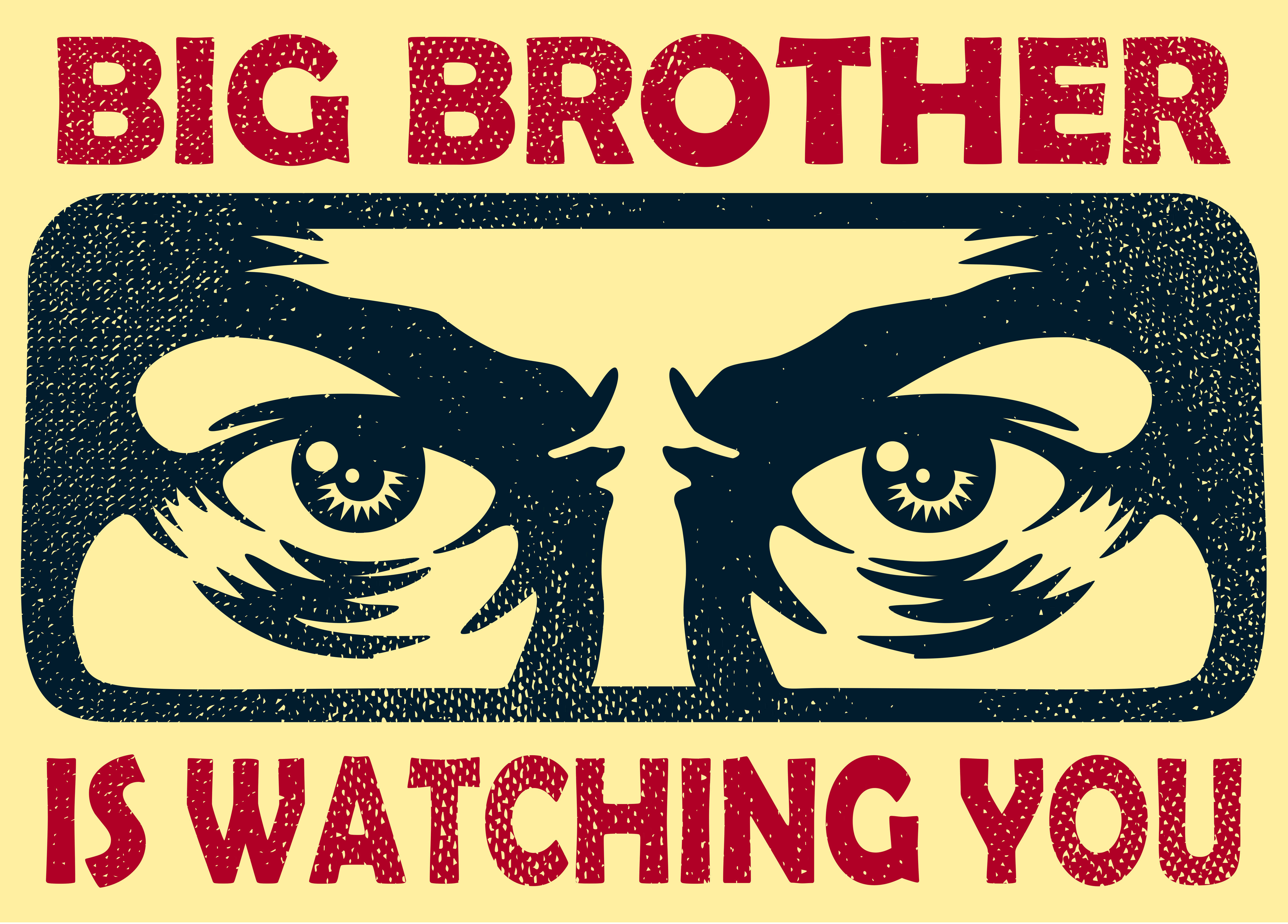
“It depicted an enormous face, more than a meter wide: the face of a man about forty-five, with a heavy black mustache and ruggedly handsome features…It was one of those pictures which are so contrived that the eyes follow you about when you move. BIG BROTHER IS WATCHING YOU, the caption beneath it ran.”
You’ve heard his name. You’ve watched the show. You may even be familiar with the Kanye West track. Big Motherfucking Brother, in the flesh—or at least on a poster. Now, finally, we can see what the hype is all about. What does his introduction reveal? (1-2)
He appears first as an image, not as a character, and his face is large, imposing, suggestive of a cult of personality. We’ve got to question at this point if he’s even real, or just some mustachioed mascot cooked up by the real powers-that-be
He’s forty-five, which is the perfect age. Smack between 30 and 60. Young enough to still be vigorous and vigilant, old enough to possess wisdom and experience
He’s “ruggedly handsome”—Of course he’s hot It’s human nature to trust the hot ones, to tolerate them a bit more—at least more so than if Big Brother were some scrawny, chinless millennial staring down from the wall. “Rugged” is doing some work here, too. He’s masculine, sturdy, strong
The eyes that follow you wherever you go, coupled with the caption, reveal a world where the individual—at least in public—is always under the watchful eyes of the state. As the Joads, Billy Pilgrim, and the Savage had their freedoms restricted and obliterated at the hands of political and economic systems so too do we find Winston at the mercy of one. Here, power seems to be exercised through surveillance. But how exactly does it work?
The telescreen is listing off figures related to the “production of pig iron”. Its volume can be turned down, but never muted. This is a deep violation of one’s privacy, a person’s right to solitude and silence. Why, out of all the propaganda the state could be broadcasting into the home, are they flexing the production of some good related to steel? My instinct is that the citizens have been sold a narrative that ties their own well-being to economic growth, even if this growth is completely detached from them and does nothing to fix the hallways that smell of cabbage. The official narrative of abundance and production is already clashing with the reality on the ground
INGSOC—don’t know what this is yet, but it’s definitely going to matter
“It was the police patrol, snooping into peoples’ windows. The patrols did not matter, however, Only the Thought Police mattered.” The police peeking into the windows of homes from helicopters further develops the surveillance state, but the narrator subverts such a notion by suggesting that they don’t actually matter, only the Thought Police matter. The helicopters are only for show. Does this suggest that the government is more concerned with policing the mind than in policing movement? Why might that be? How can that be?
Not only is private life bombarded continuously with streams of information; private life is done away with altogether: “You had to live—did live, from habit that became instinct—in the assumption that every sound you made was overheard, and, except in darkness, every movement scrutinized.” (3)
The Ministry of Truth, his place of work, towered vast and white above the grimy landscape.” A symbol of omniscience, purity, and grandeur—monumental and looming—a glaring and telling contrast to the gloomy city it overlooks
On London, chief city of Airstrip One: “Were there always those vistas of rotting nineteenth century houses, their sides shored up with balks of timber…” Interesting inversion, here. In America and I’m sure in London, too, old, historic houses and neighborhoods are celebrated and preserved, valued for their architecture and insight into the age, yet in this London these homes have fallen into destitution, garden walls and all. It hints at a society in which the past is disregarded and neglected, considered irrelevant, unworthy of reverence or even remembrance
Winston looks at the bombed sites and can’t remember if London was always like this with its “sordid colonies of wooden dwellings.” The bombs falling signaled a shift from one world to the next, a before and an after. Winston cannot imagine the world as it once was. Was is he too young to remember, has he forgotten, or was he made to forget? (3)
“The Ministry of Truth—Minitrue, in Newspeak—was startlingly different than any other object in sight.” So they have their own language, Newspeak, which is a bastardization, truncation of the English language. If we look at this single example here of “Minitrue” it does a couple of notable things. One, it rolls off the tongue, sounds almost childish, and therefore more innocuous and unthreatening. Two, it clips the words “Ministry” and “Truth”. The former is a component of the administrative about which people may express discontent; the latter refers to broader, fundamental ideals about reality itself. What is the point of these nicknames?
The three slogans of the party. You’ve probably seen these all over the internet, too. I’m just going to take a stab at each, but we’ll have to keep these in mind as we read. Slogans are big.
War is Peace—my guess here is that this relates to the idea that only constant war or at least preparation for it can create lasting peace, because only superior firepower can bring the security needed for peace. The drone strikes in the Middle East us millennials grew up are one example. Maybe they were effective, maybe they took out some bad guys, but all I know is sitting on the bus on the way to seventh grade, I felt safer knowing that at that very moment a Predator drone was gliding above the Hindu Kush. But was I?
Freedom is Slavery—this is a tricky one because it can be read so many different ways and I’m not really sure which direction to go. Maybe it’s something about human beings being slaves to their own impulses and emotions, even when living in a “free” society, and so not really being free at all? That feels half-baked, but it’s all I got for now
Ignorance is Strength—there may be more to this but I’d give I feel like it’s more surface level than the others. Ignorance is strength because it does not allow for doubt, and doubt destabilizes eve the strongest minds
Or maybe there is no underlying philosophy or symbolism to the slogans at all. Maybe it’s simply an exercise in control. They force the party members to speak absurdities, to speak untruths, to speak to an unreality in order to assert their dominance over the individual
On page 4, Winston gives a break down of the 4 ministries:
Ministry of Truth/Minitrue—Concerns itself with news, entertainment, education, and the fine arts. Where Winston works, but we don’t know much about his job yet
Ministry of Peace/Minipax—Concerns itself with war. In line with the slogan “War is Peace”, and we’ll stick to that interpretation for now. The Ministry of Peace conducting the business of war is no contradiction, because peace can only be maintained through constant war
Ministry of Plenty/Miniplenty —Responsible for economic affairs, its name not a neutral descriptor but a word invoking abundance and excess, even though we already know razor blades are a scarce commodity
Ministry of Love/Miniluv—Concerns itself with law and order. It’s the most frightening one all, a place with no windows. Why would the place of law and order be called the Ministry of Love? Is it because this law and order is carried out in the name of love, safety, and family? Is it because Big Brother loves us and wants us to be safe? Or could it be something different altogether? (4)
Victory gin — reminds me of soma, something to take the edge off, to make the intolerable slightly more tolerable: “The next moment, however, the burning in his belly died down and the world began to look more cheerful” (5)
So there are the Victory apartments, Victory gin, and Victory Cigarettes. Daily things donning the name of triumph, reminding the tenant and the drinker and the smoker of the ongoing, never-ending battle. Something to think about next time you drink a Sour Monkey which is 9.5% by the way
Winston can avoid the eyes of the telescreen by sitting in the alcove that probably “intended to hold bookshelves.” Though the bookshelves are no longer there but that the space still provides Winston an “escape” as a book might have once once is notable—the power of knowledge reaching into the present and propagating itself, however indirectly and different
“Even with nothing written in it, it was a compromising possession.” The crime is not the act of writing, nor is the crime what you write. The crime is possessing something to write in at all—to even begin to think about writing. Why does the crime begin with a purchase and not putting pen to paper?
On the diary: “This was not illegal (nothing was illegal, since there were no longer any laws), but if reasonably certain that it would be punished by death, or at least by twenty-five years in a forced-labor camp.” Legality is an old, cumbersome concept that only gets in the way, and it makes sense why the government operates under this “lawless” system instead. The law is neutral, the law is sacred, the law is a product of history, the law gives power to the individual. It’s more convenient for Big Brother to have no laws at all—for no concept of legality or justice to even exist—so that questions of fundamental rights can never even enter the heads of the citizenry, and even if they did the people lack the language to fight back (6)
“To mark the paper was the decisive act.” I feel like this is a double commentary on the real-world danger that writing in the diary invites, and also on the decision of Winston (and man) to commit to the recording of history in the face of devastation, an expression of hope that one day things will be better and that lessons will be learned from those who suffered through terrible times. He thinks it himself: he is writing “for the future, for the unborn.” It’s an act of hope, an assertion of a different way of life, and that’s dangerous
April 4th, 1984— Winston’s uncertainty surrounding the date—and the impossibility of pinning a date down within a year or two—further illustrates his country as a place disconnected from time and history. Dates mark anniversaries; dates mark marriages and massacres. By muddling time the state is able to disorient its people, providing no account of the past from which the people can orient themselves toward the present and future, and simultaneously affording it no meaning
Yet Winston expresses doubt about this: “Either the future would resemble the present, in which case it would not listen to him, or it would be different from it, and his predicament would be meaningless.” He’s alone in his struggle, isolated by the people around him, and those of the future who he doesn’t think will understand. I don’t agree that his predicament will be meaningless to the future, however (7)
Doublethink—We know this is important, but I don’t think this passage is really giving us much here. Let’s keep an eye on this one
Winston writes about the flicks he saw last night, all about wars, violent scenes that seem to function as propaganda. He watches a ship of refugees being bombed in the Mediterranean, “ a middleaged woman” and a “little boy screaming with fright and hiding his head between her breasts and the woman putting her arms around him and comforting him” and then goes on to describe the bomb that the helicopter launches at them, and a “wonderful shot” of a child’s arm flying through the air. At this the Party members in the audience cheer. Whoever the enemy is, they seem to have been completely dehumanized in the eyes of the Party, and the Party members completely desensitized to violence. These films seem intended to stoke fear, tribalism, and nationalism—keeping the people whipped up against invaders
The only person who objects in the audience is a “prole” who insists the severed arm is too much for children in the audience.“Nobody cares what the proles say typical prole reaction they never—”, Winston writes. I feel like prole has to refer to proletariat here, the working class who apparently live totally different lives from the members of the Party, and with different values too. Why is this woman offended while the Party members cheer? What distinguishes her from the Party member?
It’s worth noting that writing down this memory triggers another one for Winston. Is that why the act of writing will get you killed? Retrieving one memory, however harmless, can lead to another memory, and that one might be at odds with the narrative of the present day. Or maybe it has nothing to do with contradictory facts at all and only imagination, because if you can imagine at all, you can imagine a different world, you can question (9)
The Girl from the Fiction Department—she’s 27, with flowing hair and athletic movements, a symbol of womanhood and vitality. The scarlet sash of the Junior Anti-Sex League that brings out the “shapeliness of her hips” is an ironic detail, one that points to the control of the Party over the body, the denial biological and human reality
Winston dislikes her, “because of the atmosphere of hockey fields and cold baths and community hikes and general clean-mindedness which she managed to carry about with her.” Her image is sanitary, surface-level, curated by the party and lacking depth
“He disliked nearly all women, and especially the young and pretty ones, who were the most bigoted adherents of the party, the swallowers of slogans, the amateur spies and nosers-out of unorthodoxy.” What’s the explanation? Does the Party give the women a sense of meaning and belonging, does it give them power over their neighbors that they otherwise wouldn’t have? Is Winston’s perception even correct?
O’Brien— a member of the Inner Party, who gives off a “civilized” and noble air that seems from an older, different time, like the ink pen and London homes. Winston sees intelligence in O’Brien’s face: “He had the appearance of being a person that you could talk to…”
So basically we have to characters introduced here who are polar opposites in Winston’s mind: one could be Thought Police and the other could be a rebel. Obviously we should be skeptical of initial impressions, but these two characters are probably going to be important (10)
The Two Minutes Hate features Emmanuel Goldstein, “the enemy of the people”, whose appearance on the screen elicits hisses and cries of disgust from the audience
Goldstein was a former party member, “almost on a level with Big Brother himself.” He is the principal figure in the Two Minutes Hate, “the primal traitor, the earliest defiler of the Party’s purity” and all crimes against the Party spring from his teachings
He’s a convenient figure. The antithesis of Big Brother, the ugly, not ruggedly-handsome foil to him, against which Big Brother only becomes more meaningful, necessary, and heroic
He’s alive somewhere and “hatching conspiracies” but he seems to function more as the personification of the citizenry’s fears, whatever those may be. There’s no reference to some any specific plot or suspected plot
That all crimes stem from his teachings is significant, too. A person who commits a crime does not do so out of her own volition, and a sense of right and wrong—she does Goldstein’s spell. It allows the party to deny the human agency that is so dangerous to them. No sane, civilized person would rebel on their own—they must be corrupted by some sinister force
Winston’s diaphragm constricts at the Jewish face of Goldstein and his sheeplike qualities, yet he recognizes Goldstein’s attacks on the Party were “so exaggerated and perverse that a child should have been able to see through it, and yet just plausible enough to fill one with an alarmed feeling that other people, less level-headed than oneself, might be taken by it.” Winston seems to recognize that Goldstein’s main appeal is emotional—why is this unsettling to him?
Goldstein denounces the Party, promotes freedom of speech, freedom of the press, freedom of assembly—certainly ideals we as Americans are familiar with. I’m surprised to see these ideals vilified so directly by the Party, and curious about how they’re able to pull that off (12)
“Behind his head on the telecreen there marched the endless columns of the Eurasian army—row after row of solid-looking men with expressionless Asiatic faces, who swam up to the surface of the screen and vanished, to be replaced by others exactly similar.” The most potent image of the invader we’ve seen thus far—not the one who invades the home through the telescreen but the one who comes across the border, the one who does not look like us or feel like us, who comes wave after wave, threatening our way of life. There’s no evidence yet that Winston or other citizens in London have ever truly been endangered by these “hordes”, but the image is enough to invoke terror
Though the external enemy flip-flips from Eurasia to Eastasia (more on that later), Goldstein’s is always the foremost enemy, a stand-in for chaos and violence that deflects attention and criticism away from the party, to an external enemy that we can all stand against. Goldstein is hated, everyday the people are reminded of his threat, “yet his influence never seemed to grow less.” Hmmmm. (13)
In the final minute Winston joins in the Two Minutes Hate fully, because its impossible to not get caught up in the “hidden ecstasy, a desire to kill, to torture, to smash faces with a sledge hammer…” He succumbs to the mob mentality, the “electric current” that flows through the group, deep-rooted emotions unleashed by images of the enemy of the screen—the death and destruction they threaten to unleash
“And yet the rage one felt was an abstract, undirected emotion which could be switched from one object to another like a blowlamp.” Winston channels his rage first at Big Brother and then his counterpart, Goldstein, inhabiting two clashing perspectives. He is first angry at the Big Brother and the Thought Police and their lies, and feels for Goldstein who stands for truth. But then he sees the truth as the Party sees it. He adores Big Brother, who “seemed to tower up, an invincible, fearless protector, standing like a rock against the hordes of Asia” and sees in Goldstein only evil, civilization-ending intention. That Winston can inhabit both mindsets attests to the malleability of man, how he can be equally motivated by both truth and fear depending on the circumstances, and that emotion can and does override truth
Winston then transfers his hate the girl and imagines doing violent things to her. “He hated her because she was young and pretty and sexless, because he wanted to go to bed with her and would never do so”…because of the “odious scarlet sash, aggressive symbol of chastity.” Why does the scarlet sash enrage Winston so much? Is he really just mad he’ll never hit? Or is it something deeper, a more universal disgust at the inversion of the world, the unnatural state of a society that represses and denies sexuality and youth and in doing so suppresses beauty, connection, and meaning?
Goldstein literally turns into a sheep at the end of the hate: dehumanization of the enemy, a tale as old as time. The submachine gun roars out from the screen so realistically that the people in the front seats jump, a reminder that they are in danger, that this chaos can come for them and kill them at any moment. Then the face dissolves into that of Big Brother, and the people are saved again (15)
The B-B chanting shit is weird, and Winston acknowledges it as such: “he could not help sharing in the general delirium, but this subhuman chanting of B-B! always filled him with horror.” Why does Winston find the chanting more unnerving than the rage? Is it the religious connotation, the elevation of Big Brother into a Christlike figure, a savior? Or is it the simple subjugation of it, the groveling of one human being before another, the tossing away of logic and rationality and independence in the name of meaning and security
The eye-contact with O’Brien is a big moment, though it may be in Winston’s head. He imagines O’Brien as understanding: “‘I am with you’, O’Brien seemed to be saying to him… ‘I am on your side!’” This reminds me of high school, sitting in the cafeteria and making eye contact with your crush sitting two tables over. It was probably incidental, it probably means nothing, yet the mind clings to the most hopeful, exhilarating, delusional speculation: you’ve spoken to her twice in two years, yet she knows how you feel, and she feels it too. Such undeniable eye contact never amounted to the passionate make out sessions I was sure it would, but I’m hoping it turns out different for Winston
“And then the flash of intelligence was gone, and O’Brien’s face was as inscrutable as everybody’s else’s.” I’m curious about the trust Winston seems to be placing in a person’s appearance intelligence. I agree that you can often see intelligence in one’s face. But is it a given that all intelligent people are opposed to the Party? One would like to think… (17)
DOWN WITH BIG BROTHER—I mean pretty on the nose here. The repetition and capitalization suggests an almost frantic rage, driven by Winston’s clarity, his sense of humanity and justice. He’s starting at this point, though, and given the fact there’s two hundred pages remaining, he’s definitely gonna get in some deep shit
“Whether he went on with the diary, or whether he did not go on with it, made no difference. The Thought Police would get him just the same. He had committed—would still have committed, even if he had never set pen to paper—the essential crime that contained all others in itself. Thoughtcrime, they called it. Thoughtcrime could not be concealed forever. You might dodge successfully for a while, even for years, but sooner or later they were bound to get you.” Thoughts, not actions, are what will get you disappeared. It’s every strongman’s dream. Yet I wonder how much of this is psychological warfare versus real technical ability—how much of it is just about establishing an image of omniscience and inevitability which serves the same purpose: the suppression of critical thought
“People simply disappeared, always during the night.” A horror that appears in the history books time and time again, the unaccountable secret police indispensable to every authoritarian regime, inspiring fear and suppressing dissent. Orwell was no doubt responding to the great horrors of the 21st century that he witnessed unfold in Nazi Germany and the Soviet Union
“Your name was removed from the registers, every record of everything you had ever done was wiped out, your one-time existence was denied and then forgotten. You were abolished, annihilated: vaporized was the usual word.” Simple imprisonment or execution is not enough; the thought criminal must be erased. It prevents him from being used as a martyr, and maintains the narrative of a in full support of Big Brother. It also serves as a threat to the wannabe rebel, too. He cannot be motivated by glory or martyrdom; he instead will pass into nonexistence, which in some abstract way is a fate more terrifying than a bullet to the back of the head. His physical presence, even his corpse, is eviscerated. Dying is scary, erasure is scarier. We like to think that we’ll leave a mark, at least for a little while
they’ll shoot me in the back of the neck i dont care down with big brother they always shoot you in the back of the neck. The italics and lack of punctuation and capitalization give insight into Winston’s frenzied state of mind. He sees the world clearly and he knows that with this clarity comes danger—and not a glorious, heroic death but one you don’t even see coming, an end without ceremony, reflection, or meaning. Yet that can’t stop him from writing the truth. Despite all we’ve seen so far, the terrifying mechanisms in place to keep the people in line, Winston’s mind is still free. But how many others are free? And does it even matter?
And that brings us to the end of chapter one. An absolute shit ton of things to dig into going forward, but I think we’ve laid the groundwork for some effective (and hopefully shorter) analysis going forward.
As always, drop your comments below. There is a lot up to interpretation to this and I want to know what you guys think, whatever stood out to you the most. I will do my best to respond to all comments promptly to hopefully facilitate some real discussion so please, don’t be shy.
As for the next post, Chapters 2-4 will be posted on Sunday, 1/11.
Chapters 5-7 will be posted on Thursday, 1/15, which will bring us to around page 80.
Keep reading.
Steve